



Is your current SQL Accounting software struggling to keep pace with your company’s rapid growth? While it served you well in the beginning, disconnected departments, manual data entry, and slow reporting often become major roadblocks as you scale. You need a solution that unifies your entire business—not just your financials.
The time is right for a change. Moving to SAP Business One is the correct strategic choice, giving you a powerful, integrated ERP platform built for small and midsize enterprises.
The Pain Points of Outgrowing SQL Accounting
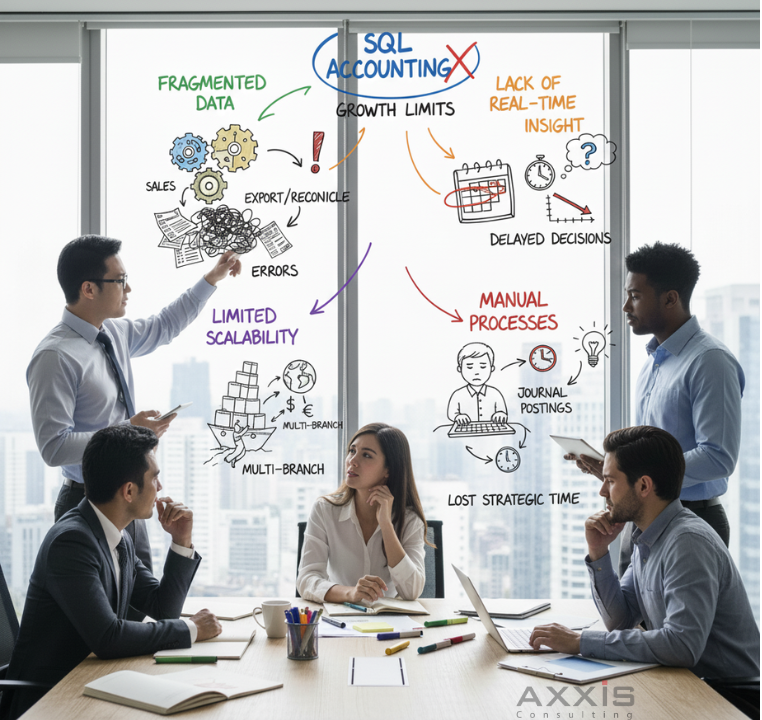
SQL Accounting excels at core bookkeeping, but as your company expands, you inevitably hit its limitations. These challenges typically surface across multiple departments:
-
Fragmented Data: Your sales, inventory, and accounting information live in separate silos. Consequently, you spend too much time exporting and reconciling spreadsheets, increasing the risk of costly errors.
-
Lack of Real-Time Insight: You often wait for month-end reports to analyze your financial health. Because of this delay, you cannot make fast, data-driven decisions that today’s market demands.
-
Limited Scalability: Your current system may struggle to handle increasing transaction volumes or complex international operations (multi-currency, multi-branch).
-
Manual Processes: Tedious, repetitive tasks like double data entry or journal postings consume valuable employee time, pulling them away from strategic, high-value work.
Ready to solve your fragmented data problems? Contact us today for a free consultation to map your current challenges to the right SAP solution!
The Game-Changing Features of SAP Business One
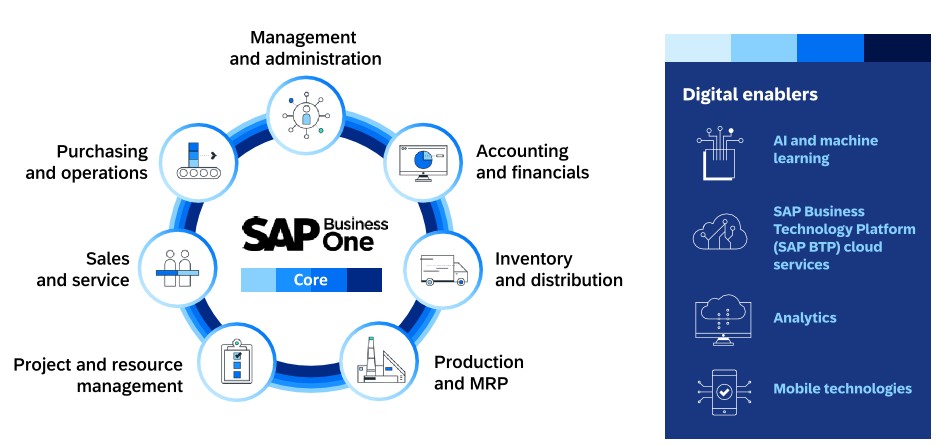
SAP Business One (SAP B1) is a single, integrated ERP (Enterprise Resource Planning) platform that manages your entire business—from accounting to customer relationship management (CRM) and inventory. It doesn’t just manage your numbers; it runs your whole operation.
1. Holistic Business Integration
Unlike a pure accounting system, SAP B1 unifies all core business functions:
-
Financials & Accounting: Automate journal entries, track fixed assets, and manage budgets in real-time.
-
Sales & CRM: Manage leads, opportunities, and customer service—all linked directly to inventory and invoicing.
-
Purchasing & Inventory: Optimize procurement, track stock movements, and calculate accurate costing.
-
Reporting & Analytics: Utilize powerful, built-in dashboards and reports that provide instant, actionable insights.
2. Real-Time Data and Reporting
SAP Business One gives you a true “single version of the truth.” Furthermore, every transaction immediately updates all related financial records. Therefore, managers can access live dashboards, gaining instant visibility into cash flow, sales performance, and inventory levels to make quicker, smarter decisions.
3. Future-Proof Scalability
SAP B1 is explicitly designed to grow with you. You can seamlessly add more users, new modules (like manufacturing or service), and scale operations without changing your core system. This means your initial investment remains relevant and powerful for years to come.
Calculating Your Return on Investment (ROI)
The move from SQL Accounting to an ERP like SAP Business One represents a strategic investment, not just a cost. Here is how companies realize a powerful ROI:
| ROI Driver | Impact with SQL Accounting | Impact with SAP Business One |
| Operational Efficiency | High time spent on manual data entry and reconciliation. | Automation cuts data entry by up to 50%, allowing employees to focus on analysis. |
| Financial Closing | Often takes days or weeks to get an accurate month-end close. | Real-time integration and automation can shorten monthly close time by up to 40%. |
| Inventory & Purchasing | Difficult to track true costs and manage optimal stock levels. | Better control reduces inventory carrying costs by 10-25% through improved demand forecasting. |
| Decision-Making | Relies on historical, often fragmented data. | Instant, unified reports lead to better strategic decisions, directly boosting profitability. |
Companies often experience a positive ROI within 12 to 18 months, driven by reduced errors, lower operational costs, and accelerated growth. Choosing SAP Business One means investing in a platform that actively contributes to revenue and efficiency.
Is Your Business ERP-Ready? Download Our Checklist!
Many SMEs run on software like SQL Accounting—and for a time, it works. But as your business grows, so do your needs: inventory gets messy, reporting takes too long, and operations feel disconnected. This guide helps you determine if you are ready to take the next step toward ERP (Enterprise Resource Planning).
It is a practical, non-technical checklist designed for business owners, finance leads, and operations managers. Download our comprehensive ERP Readiness Checklist now to objectively assess your current system’s limitations and identify the signs that your business has outgrown its accounting software.
See the features in action! Request a demo to see how SAP Business One specifically tackles your business bottlenecks.
Partnering for Success: Choose Axxis Consulting
Implementing an ERP system requires more than just great software; it demands an expert partner. Axxis Consulting is a certified SAP partner with extensive local and industry experience.
We don’t just sell software; we deliver successful digital transformations. Axxis Consulting specializes in guiding small and midsize businesses through a smooth transition from systems like SQL Accounting to the fully integrated world of SAP Business One. Our dedicated team ensures a quick, efficient implementation and provides long-term support, ensuring you maximize your ROI.
Axxis Consulting empowers you to simplify your technology, unify your data, and drive profitable growth.
Moving to SAP Business One Is the Right Choice
If you are experiencing the growing pains of a successful business—if you need more than just accounting, if you demand real-time visibility, and if you plan to scale regionally or internationally—then upgrading to SAP Business One is the necessary step. Stop wrestling with the limitations of SQL Accounting and embrace an integrated future.