





In the lifecycle of every successful business, you eventually reach a “tipping point.” This is the exact moment when the tools that powered your launch—those lean, user-friendly cloud apps—stop being a support system and start feeling like a set of handcuffs.
Perhaps you launched your journey with Bukku or Xero because they offered affordability and an easy setup. Maybe you relied on QuickBooks or MYOB to manage your early invoicing and basic ledgers. However, as your transaction volume surges, your supply chain grows complex, and your team expands, you inevitably realize that standard “accounting software” no longer cuts it. You don’t just need a ledger; you need a “business engine.”
In the Southeast Asian market, business owners often view local heavyweights like SQL Accounting or AutoCount as the traditional next step. While these tools offer robustness, they frequently represent a lateral move rather than a true strategic leap.
If you currently feel the limitations of basic software, your choice for 2026 should move beyond just a “bigger” accounting package. Instead, you must prioritize an Enterprise Resource Planning (ERP) solution like SAP Business One (SAP B1).
The Starting Line: Why We Love (and Eventually Leave) Simple Software
For startups and small businesses, platforms like Bukku, Xero, and QuickBooks revolutionized the industry. They successfully democratized accounting by moving data to the cloud and stripping away intimidating financial jargon.
-
Bukku: This platform automates the workflow for Malaysian SMEs, offering a localized, tax-compliant (SST and e-Invoicing) cloud solution that appeals to modern entrepreneurs.
-
Xero & QuickBooks: These act as the global gold standards for “beautiful accounting.” They leverage massive app ecosystems and intuitive user interfaces to simplify daily tasks.
-
MYOB & QNE: As long-standing pillars in the region, these providers have transitioned from desktop-heavy roots to hybrid cloud models, offering reliable compliance and payroll features.
These platforms excel at “Financial Recording.” They tell you exactly what happened to your money yesterday. However, they do not facilitate “Operational Execution.” As you scale, you will notice three critical cracks in your foundation:
1. Siloed Data: Your sales team operates in one CRM, your warehouse uses a standalone inventory tool, and your finance team reconciles in Xero. Consequently, nothing communicates in real-time.
2. Manual Consolidation: If you manage multiple entities, closing the month-end becomes a nightmare of Excel spreadsheets and manual adjustments.
3. Inventory Blind Spots: Basic software handles “stock in/stock out” reasonably well, yet it buckles under the pressure of complex manufacturing (BOM), multiple warehouse locations, or sophisticated landed cost calculations.
The “Intermediate Trap”: The SQL and AutoCount Dilemma
When these operational cracks appear, many business owners instinctively search for “stronger” accounting software. In Malaysia and Singapore, this search usually leads to a comparison between SQL Accounting, AutoCount, or QNE.
While these systems represent a step up—handling higher transaction volumes and offering deep roots in local tax requirements—they remain fundamentally accounting-centric.
Why should you consider skipping this step? If you upgrade from Xero to SQL or AutoCount, you essentially just buy a more powerful calculator. You will likely still face disconnected processes and fragmented data. Furthermore, you may find yourself in the exact same predicament two years from now, realizing you’ve outgrown your “intermediate” software and must endure yet another painful, expensive migration.
The Real Leap: Why SAP Business One is the Strategic Choice
If you are upgrading from basic accounting software today, you should choose SAP Business One over SQL or AutoCount. SAP B1 functions as a complete ERP, not just an accounting tool. It integrates every department—from the warehouse to the front office—into a single source of truth.
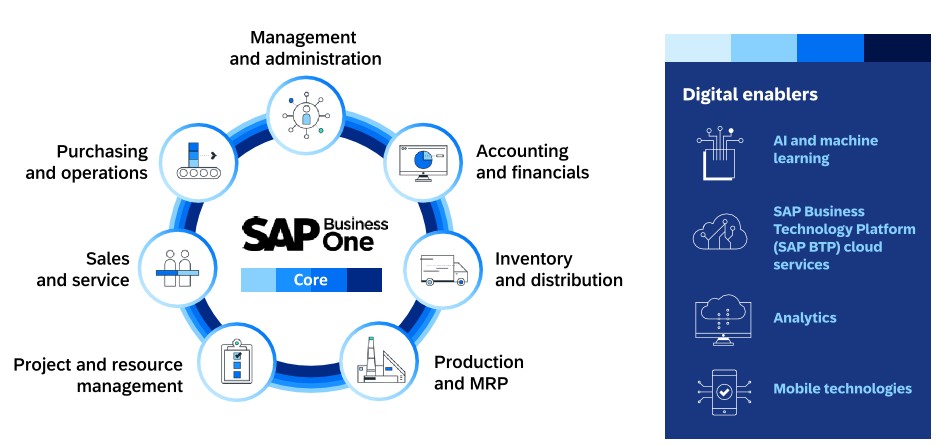
A. Beyond Bookkeeping: Total Operational Control
While SQL or AutoCount might alert you that stock is low, SAP B1 actively manages your entire procurement lifecycle. It utilizes Material Requirements Planning (MRP) to predict your purchasing needs based on sales forecasts. By integrating Warehouse Management (WMS) to track bins and batches, SAP B1 ensures your operations drive your accounting—not the other way around.
B. Real-Time Analytics with SAP HANA
In 2026, data serves as your most valuable currency. Unlike the static, historical reports found in MYOB or QuickBooks, SAP B1—powered by the HANA in-memory database—processes complex analytics across millions of rows of data in seconds. You gain interactive dashboards that visualize your cash flow, sales trends, and profit margins the moment they change.
Stop guessing your technology costs and start planning your growth—Get an Instant SAP Business One Price Quote to see how affordable enterprise-grade power can be.
The Ultimate Implementation Checklist: Transitioning to SAP B1
Transitioning from a lean app like Bukku to an enterprise powerhouse like SAP B1 requires a structured approach. Use this checklist to ensure your migration is seamless and successful.
Phase 1: The Process Audit
[ ] Map Your Workflows: Document your “Quote-to-Cash” and “Procure-to-Pay” cycles. SAP B1 will automate these, but you must first define them.
[ ] Identify Spreadsheet Dependencies: List every manual Excel sheet your team currently uses to “bridge the gap” between your old software and your operations.
[ ] Appoint a Project Champion: Select a lead from your internal team who understands both your finance and your operations.
Phase 2: Data Cleansing & Preparation
[ ] Scrub Your Master Data: Export your customer and vendor lists from Xero or QuickBooks. Remove duplicates and update tax IDs to ensure seamless e-Invoicing.
[ ] Standardize Your SKUs: If your current inventory list is messy, rename and categorize your SKUs before importing them into SAP B1.
[ ] Review Your Chart of Accounts: Transition from a “flat” list to SAP B1’s segmented, multi-level Chart of Accounts for better financial reporting.
Phase 3: Configuration & Customization
[ ] Define User Permissions: Set clear roles so that your warehouse team, sales team, and finance team see only the data relevant to them.
[ ] Establish Approval Workflows: Configure the system to automatically flag and route high-value transactions for management approval.
[ ] Integrate e-Invoicing: Ensure your SAP B1 environment connects directly to local tax authorities (like LHDN in Malaysia, IRAS in Singapore) for real-time validation.
Phase 4: Testing & Training
[ ] Conduct User Acceptance Testing (UAT): Run a “day in the life” simulation where staff process real orders in a test environment.
[ ] Validate Financial Balances: Ensure your opening balances in SAP B1 perfectly match your closing balances in your old software.
[ ] Staff Training: Invest in hands-on workshops so your team feels confident navigating the new ERP interface.To ensure a smooth transition into SAP B1, Axxis Consulting provides training for all users who choose us as their implementation partner.
Comparing the Landscape: A High-Level View
| Feature | Simple Cloud (Xero/Bukku/QB) | Local Intermediate (SQL/AutoCount) | Enterprise ERP (SAP Business One) |
| Primary Focus | Bookkeeping & Invoicing | Financial Compliance | End-to-End Operations |
| Inventory | Basic (Needs Add-ons) | Moderate | Advanced (MRP, Batch, Serial) |
| Scalability | Low (Transaction caps) | Moderate | High (Unlimited Growth) |
| Database | Multi-tenant Cloud | SQL Server | SAP HANA (In-Memory) |
| Customization | Low | Moderate | High (Industry Specific) |
| Reporting | Standard Financials | Detailed Local Reports | Predictive Analytics & BI |

Signs It’s Time to Upgrade to SAP Business One
How do you know if you should skip the intermediate software and go straight to SAP? Watch for these four “Scale Killers”:
1. The “Excel Dependency”: If your team spends more than 4 hours a week “fixing” data in Excel to make it presentable for management, your current software has failed you.
2. Disconnected Inventory and Sales: If you are selling products that aren’t actually in the warehouse—or worse, your warehouse is full of dead stock—you need the integrated logic of SAP B1.
3. Complexity in Production: If you are a manufacturer, basic software like Bukku or QuickBooks cannot handle Multi-Level Bills of Materials (BOM). SAP B1 is a non-negotiable requirement for anyone moving from a trading model to a manufacturing model.
4. Regulatory and Audit Pressure: As your revenue increases, so does the scrutiny from auditors. SAP B1 provides a “Golden Audit Trail,” making your year-end audits significantly faster and less stressful.
Seeing is believing—schedule your SAP Business One Free Demo today and watch how a unified ERP transforms your daily operations.
Making the Transition: From “Simple” to “Scalable”
The thought of moving from a simple interface like Xero to a powerhouse like SAP Business One can feel daunting. However, modern implementation methods have made SAP B1 far more agile than the “Big SAP” versions used by massive corporations.
-
Cloud Deployment: You can deploy SAP B1 on the cloud, maintaining the “anywhere access” you enjoyed with your previous apps, but with the added muscle of an enterprise engine.
-
Modular Growth: You don’t have to implement everything on Day 1. Start with Finance and Inventory, then add CRM, Service, or Production modules as your business evolves.
-
Localized Expertise: Experts in Malaysia and Singapore, such as Axxis Comsulting, specialize in transitioning SMEs from SQL or AutoCount to SAP B1, ensuring your local tax and e-Invoicing requirements are mapped perfectly.
Conclusion: Future-Proofing Your 2026 Strategy
Upgrading your accounting software represents a significant investment of your time and capital. The worst mistake a growing business can make is to choose a “halfway” solution that only solves today’s problems.
While SQL Accounting and AutoCount are excellent for what they are, they often act as a temporary fix. By choosing SAP Business One, you are not just buying a tool for your current size—you are securing a platform that will support your business until it becomes a household name.