

For many small and midsize companies, MYOB is the first system they use to manage accounting, payroll, and basic inventory. It’s familiar, affordable, and does exactly what a growing business needs in the early years.
But as the business expands, owners often start asking the same question: “Is MYOB enough for the next stage of growth, or do we need a full ERP system?”
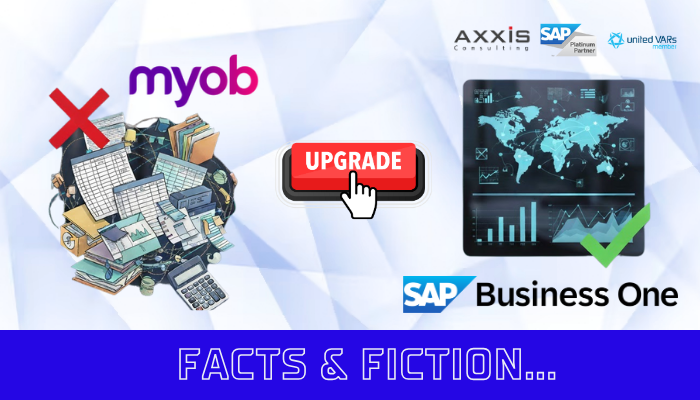
This blog explains the facts and fiction around upgrading from MYOB to an ERP solution. First, we’ll look at what MYOB does well, and then we’ll examine when its limits appear. Finally, we’ll review what ERP systems offer, and show why SAP Business One represents a natural next step for companies ready to move beyond MYOB.
1. What is MYOB – and why is it great for some companies?
MYOB (Mind Your Own Business) is accounting software designed specifically for small and midsize businesses. Its main purpose is to help companies manage:
- Finance and general ledger
- Invoicing and billing
- Bank feeds and reconciliation
- Payroll
- Basic job costing and simple inventory
- Simple financial reporting
Consequently, for many SMEs, MYOB is the perfect starter tool because it offers distinct benefits:
Benefits of MYOB
-
Easy to learn and use: MYOB is widely known among bookkeepers and accounting professionals, which significantly reduces the learning curve and makes onboarding fast and simple.
-
Low total cost of ownership: It is a cost-effective solution for small businesses, offering essential accounting functionality without requiring a large upfront investment.
-
Quick setup with minimal training: Businesses can implement MYOB rapidly without major disruption to daily operations, as only basic training is needed.
-
Covers essential financial processes effectively: MYOB supports key accounting functions such as invoicing, payments, basic reporting, and day-to-day bookkeeping.
-
Well-suited for straightforward business models: It is ideal for businesses with simple operational and financial requirements, without the need for complex system customisation.
Therefore, this is why MYOB is widely used across Australia, New Zealand, and Southeast Asia. It works extremely well as long as the business remains simple.
2. When MYOB shows its limitations
However, as companies grow, they demand more than just accounting. Specifically, they need full visibility into inventory, sales, purchasing, warehousing, production, and real-time reporting. Subsequently, MYOB users start feeling the constraints of a system that was never built as a full ERP.
Typical signs MYOB is no longer enough

- Too many spreadsheets: Your business relies heavily on multiple Excel files to manage critical operations such as inventory control, demand forecasting, purchasing, and production planning—all outside of MYOB. This creates scattered information, version control issues, and a higher risk of errors.
- Manual data entry: Your teams are forced to manually enter the same data multiple times—first into MYOB, then again into CRM systems, Excel spreadsheets, e-commerce platforms, or warehouse management apps. This not only wastes time but also increases the likelihood of duplication and data inconsistencies.
- No single source of truth: Different departments operate with different figures. Finance may see one set of numbers, the warehouse another, and the sales team something entirely different. Without a unified system, it becomes difficult to trust reports or make confident, data-driven decisions.
- Growing inventory complexity: As your business scales, inventory management becomes more complex. MYOB begins to struggle with advanced requirements such as managing multiple warehouse locations, batch and lot tracking, serial numbers, and sophisticated stock movements across sites.
- Limited reporting for decision-making: You lack the ability to easily generate meaningful insights such as profit margins by product, customer, project, or location. As a result, management decisions are often made with incomplete visibility and limited analytical depth.
- Too many disconnected systems: Your operation runs on a patchwork of MYOB, spreadsheets, and various standalone applications that do not communicate smoothly with each other. This fragmented setup leads to inefficiencies, data silos, and higher maintenance effort.
- Month-end takes too long: Financial closing and reconciliation processes become painfully slow due to the heavy reliance on manual checks across multiple systems. Your finance team spends excessive time validating numbers instead of focusing on strategic financial analysis.
At this point, companies usually wonder if they should replace MYOB with an ERP system.
3. Do you really need an ERP system? Understanding ERP vs MYOB
Therefore, to know whether you need to upgrade, it’s crucial to understand the fundamental difference between MYOB and ERP systems.
What is an ERP system?
An ERP (Enterprise Resource Planning) system integrates all major business functions:
- Finance
- Sales & CRM
- Purchasing
- Inventory & warehouses
- Production & MRP
- Projects & job costing
- Service management
- Reporting & dashboards
In effect, instead of multiple tools, an ERP gives everyone one system with real-time data.
ERP vs MYOB: Key Differences
| Function | MYOB | ERP System |
| Scope | Mainly accounting + basic inventory | Finance, sales, CRM, purchasing, production, service, projects |
| Integration | Often requires spreadsheets or 3rd-party tools | All departments share one database |
| Reporting | Basic financial reporting | Real-time financial + operational analytics |
| Automation | Limited | Full workflow automation across business processes |
| Scalability | Ideal for small/simple companies | Built for business growth and higher complexity |
Common misconceptions about ERP
-
Fiction: “ERP is only for large companies.”
-
Fact: Modern ERP systems like SAP Business One are designed specifically for SMEs.
-
-
Fiction: “ERP is too expensive.”
-
Fact: Cloud ERP subscriptions are now affordable and scale with your business.
-
-
Fiction: “ERP will slow us down.”
-
Fact: ERP removes manual work and gives real-time visibility, speeding up operations.
-
When do you truly need ERP instead of MYOB?
You should consider upgrading when:
- Inventory becomes complex (multi-warehouse, batch/serial tracking).
- You run production or assembly.
- You have more than one business entity.
- Your reporting requires margin or cost visibility across departments.
- Spreadsheets grow faster than the business.
- You need automation and approval workflows.
- You plan to scale in size, locations, or product lines.
If these factors describe your business, then an ERP upgrade is a strategic move—not a luxury.
4. Why SAP Business One is the natural next step after MYOB
Consequently, when MYOB users decide to move to a full ERP system, they frequently choose SAP Business One. It’s built for SMEs and provides the necessary next level of capability without overwhelming complexity.
What SAP Business One offers
SAP Business One handles all core functions of your business:
- Complete financial management
- CRM and sales
- Purchasing and supplier management
- Inventory, warehousing, batch/serial tracking
- Production and MRP
- Project and job costing
- Service management
- Embedded analytics and dashboards
- Cloud or on-premise deployment
Also Read: SAP Business One Pricing & Overview
Why MYOB users prefer SAP Business One
- From Accounting to ERP—Made Easy: Move from MYOB to SAP Business One with confidence. Familiar financial tools mean a smooth transition and faster adoption for your team.
- See Your Business in Real Time: Sales, purchasing, inventory, and finance—all connected. Make smarter decisions instantly with complete visibility across your operations.
- Powerful Tools for Inventory & Production: Optimize stock, streamline production, and manage your supply chain efficiently. Perfect for distributors, wholesalers, retailers, and manufacturers.
- Grow Without Limits: SAP Business One scales with your business. Add users, expand operations, and embrace complexity without workarounds.
- Future-Ready Automation & AI: Automate workflows, reduce manual effort, and unlock insights with AI-ready features—capabilities MYOB can’t match.
Axxis Consulting: Your SAP Business One Partner
Axxis Consulting is a leading SAP Platinum Partner in Asia. We offer decades of experience helping SMEs successfully transition from MYOB to SAP Business One.
Learn more: https://axxis-consulting.com/sap-business-one/
Conclusion: Upgrading from MYOB to ERP – The Facts
- MYOB is excellent for small businesses with simple operations.
- As your business grows, however, MYOB may not provide the visibility, control, or automation you need.
- A modern ERP system replaces spreadsheets and disconnected apps with one integrated platform.
- SAP Business One is the ideal next step for MYOB users who want a proven, scalable, SME-friendly ERP solution.
If you want help assessing whether your business is ready to upgrade from MYOB to an ERP system, Axxis Consulting can guide you every step of the way.