


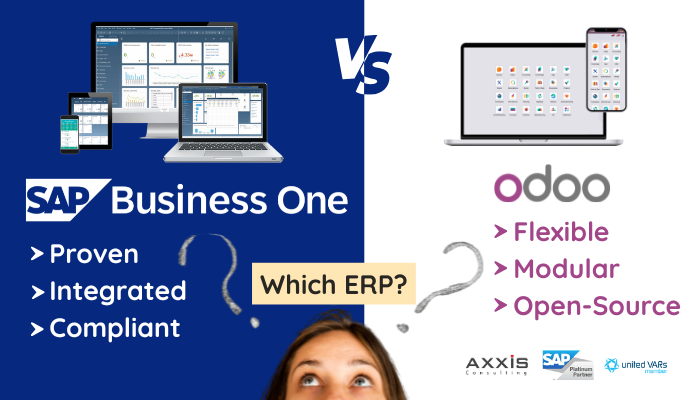
Selecting the right Enterprise Resource Planning (ERP) system is one of the most critical decisions an SME makes. Two major contenders consistently appear on the shortlist for growing businesses in Southeast Asia: SAP Business One (B1) and Odoo.
While both aim to integrate your business functions, they offer fundamentally different approaches, especially when considering the unique market dynamics of Malaysia and Singapore.
Here, we break down the key differences, helping you understand why SAP Business One is often heralded as the best-fit, proven ERP solution for ambitious SMEs in the region.
Odoo: The Modular Open-Source Challenger
Odoo enters the ring with a compelling narrative: an open-source, highly modular system boasting a massive ecosystem of over 40,000 community apps.
Key Aspects of Odoo:
-
Flexibility and Customization: Odoo’s modular design allows companies to start small, buying only the apps they need. This makes it highly flexible, appealing to businesses that prioritize building a highly customized, tailor-made workflow.
-
Pricing Structure: Odoo generally offers a more budget-friendly entry point, particularly with its “One App Free” plan and a clear subscription model per user per month. The lower cost of entry strongly attracts startups and businesses with limited initial budgets.
-
User Experience (UX): Users often praise the intuitive, modern, and clean web-based interface of Odoo, making it relatively easy for new users to adopt the platform.
However, this flexibility comes with a trade-off. The open-source system means you, or your hired developers, take on the full job of making all the pieces work together. You have to manage the custom code and figure out solutions when things break—often by searching community forums.
For example: If you add three different Odoo apps for Sales, Inventory, and Accounting, you must ensure they talk to each other perfectly and handle your country’s tax rules correctly. This requires extra effort and constant maintenance.
For companies that must have stable performance, guaranteed legal compliance (like e-Invoicing), and the solid backing of a major provider, this modular approach often creates more work and risk than a single, integrated platform.
SAP Business One: The Proven ERP Powerhouse for Regional Growth
In the fast-paced, highly regulated markets of Malaysia and Singapore, businesses demand an ERP that delivers both stability and local compliance right out of the box. This is precisely where SAP Business One shines, earning its reputation as the best ERP for regional SMEs.
Why SAP Business One is the Best ERP in Malaysia and Singapore:
1. Unmatched Reliability & Stability:
As a flagship solution from the global leader, SAP Business One delivers enterprise-grade reliability without the complexity or cost of SAP’s larger systems. Companies trust this structured, integrated platform to run their entire business—from finance and inventory to sales and production.
2. Guaranteed Local Compliance:
For businesses in Malaysia and Singapore, compliance is non-negotiable. SAP Business One is fully localized to handle regional tax regulations, multi-currency support, and statutory compliance, including the e-Invoicing or InvoiceNow requirements in Malaysia and Singapore. This eliminates the risk and heavy customization effort often associated with getting a global system like Odoo fully compliant.
3. End-to-End Integration:
B1 offers a singular, integrated system where all core business functions—financials, purchasing, inventory, CRM, and analytics—talk to each other in real time. Therefore, managers can access a true 360-degree view of the business instantly, making data-driven decisions faster.
4. Local Expertise and Support:
SAP maintains a robust ecosystem of certified partners globally. In Malaysia and Singapore, Axxis Consulting stands out as an experienced SAP Platinum Partner. They provide local expertise, fast implementation (often in 2-8 weeks), and dedicated post-go-live support, ensuring your ERP functions perfectly and grows with you.
Request a B1 Demo with our experienced consultant to see these integrated features in action!
Comparison: B1 vs. Odoo at a Glance
| Feature | SAP Business One (B1) | Odoo |
| Primary Strength | Stability, Deep Integration, Global Trust, Local Compliance | Flexibility, Modularity, Open-Source Ecosystem |
| Target User | SMEs valuing structure, reliability, and long-term scalability | Startups & SMEs valuing low entry cost and high customization |
| Core Structure | Unified, integrated platform (Finance, Inventory, CRM, etc.) | Modular, app-based system (buy what you need) |
| Local Support (MY/SG) | Structured, high-level support via Certified Partners like Axxis Consulting | Official Enterprise support + large community/developer network |
| Compliance & Stability | Proven, robust, and localized for Malaysia/Singapore | Requires more custom development and maintenance for compliance |
| Implementation | Predictable, guided, and often faster via partners | Varies greatly based on the number of apps and customization |
Three Examples: Why SAP Business One Wins for Scalability & Compliance
1. Financial Closing and Audits (Guaranteed Integration)
The Need: To close monthly books quickly and provide auditors with a clean, trustworthy financial report.
| Scenario | SAP Business One (B1) | Odoo (Modular Approach) |
| How it Works | When Sales raises an invoice, it automatically updates Inventory, Accounts Receivable, and the General Ledger. The data is single-source and real-time. Closing the books is fast and highly reliable because all modules are natively connected. | The Inventory App, Sales App, and Accounting App are separate modules. You must rely on the integration links working perfectly. If a custom link breaks or an app updates, you may have data mismatch issues (Example: Inventory cost in one app doesn’t match Cost of Goods Sold in the Accounting app), delaying audits and requiring manual reconciliation. |
Why B1 is Better: B1 provides a single version of the truth. You guarantee data consistency across all functions, which is essential for audit trails and investor confidence in Singapore and Malaysia.
2. Multi-Currency and Tax Compliance (Localisation)
The Need: To manage transactions in USD, EUR, and SGD while ensuring all reports comply with Malaysian tax laws (e.g., SST or the upcoming e-Invoicing).
| ERP | SAP Business One (B1) | Odoo (Modular Approach) |
| How it Works | B1 is built with local statutory requirements for both Malaysia and Singapore. It handles real-time currency conversion and applies complex local tax rules correctly on sales, purchases, and GL entries automatically. Crucially, it is continuously updated by SAP to handle major regulatory changes like Malaysia’s e-Invoicing mandate. | Odoo’s base system is global. Achieving full local tax compliance often requires purchasing or custom-developing specific localization modules. If tax laws change, you must wait for a community update or pay developers to update your custom code. |
Why B1 is Better: B1 offers guaranteed, proactive compliance straight from a global provider (SAP), saving you significant legal risk, development costs, and the headache of maintaining tax logic yourself.
3. Inventory and Warehouse Management (Real-Time Control)
The Need: A customer places a large order. Management needs to instantly know the current stock level, future purchase orders arriving, and the exact cost of the stock to calculate profit.
| ERP | SAP Business One (B1) | Odoo (Modular Approach) |
| How it Works | Because the Inventory, Purchasing, and Sales modules are one system, the moment the sales order is created, the system reserves the stock, calculates the landed cost of the item (including shipping and duties), and updates the future cash flow forecast. You get instant, accurate profitability data. | With separate modules, you risk lagging data. The Sales app might show inventory, but that number might be minutes old. The accounting app might not have the fully updated landed cost of the goods. This delay leads to potential errors like overselling or calculating a final profit margin that is wrong. |
Why B1 is Better: B1 enables true real-time decision-making. In a high-volume trading environment, you minimize overselling, ensure accurate costing, and improve customer satisfaction because you trust the single data source.
Making the Final Decision
Choosing between Odoo and SAP Business One boils down to your company’s core values.
If your company prioritizes absolute flexibility, open-source principles, and a high degree of custom, in-house technical management, then Odoo might be a fit.
On the other hand, if you run a growing business in Malaysia or Singapore and demand a proven, stable, compliant, and fully integrated ERP solution—one that offers enterprise-grade functionality at an SME price point—you should choose SAP Business One. You gain the peace of mind that comes with a global brand, backed by the dedicated local support of a Platinum Partner like Axxis Consulting.
Ultimately, most successful, scaling SMEs in the region discover that the long-term stability, guaranteed compliance, and seamless integration of SAP Business One easily outweigh the initial customizability allure of the Odoo modular approach.