




InvoiceNow is no longer just a digital convenience for tech-savvy startups; it is now the backbone of Singapore’s national digital economy. Following the 2026 Ministry of Finance announcements, the roadmap for every GST-registered business in Singapore has shifted significantly.
If you are navigating the transition from manual invoicing to a structured digital framework, you are in the right place. This guide breaks down everything from the new 2028–2031 implementation timeline to how you can leverage SAP Business One to turn a compliance requirement into a competitive advantage.
What is InvoiceNow? Understanding the “Peppol” Foundation
At its core, InvoiceNow is Singapore’s nationwide e-invoicing network. The Infocomm Media Development Authority (IMDA) launched it in 2019 to move businesses away from PDF invoices—which still require manual data entry—and toward a structured digital format.
The Power of the Peppol Standard
Unlike an email with an attachment, InvoiceNow operates on the Peppol (Pan-European Public Procurement On-Line) standard. This international framework allows different accounting systems to “speak” the same language.
When you send an invoice via InvoiceNow, the data moves securely from your ERP system (like SAP Business One) directly into your customer’s system. Consequently, this eliminates the “human middleman,” drastically reducing errors and accelerating the entire payment cycle.
Why the Change? The Compelling Benefits of Early Adoption
While the government is making InvoiceNow mandatory, the “Why” behind the movement is rooted in business efficiency. Businesses that wait until the 2031 deadline will miss years of operational optimization.
1. Accelerated Cash Flow
Cash is the lifeblood of any enterprise. Because InvoiceNow delivers invoices instantly and in a format that your customer’s system can process immediately, the “time-to-pay” shrinks. Therefore, your business enjoys better liquidity and more predictable revenue cycles.
2. Radical Accuracy and Reduced Labor
Manual data entry is the enemy of scale. By automating the invoicing process, you remove the risk of typos, incorrect GST calculations, or lost emails. Furthermore, your finance team can pivot from “data entry clerks” to “strategic analysts,” focusing on high-value tasks that grow the business.
3. “Audit-Ready” Compliance
GST audits are often stressful due to missing paperwork or inconsistent records. InvoiceNow creates a digital “paper trail” that is transparent and verifiable. Because the data flows directly to the Inland Revenue Authority of Singapore (IRAS), the audit process becomes significantly shorter and less intrusive.
The New Roadmap: Key Implementation Dates (2025–2031)

The Singapore government is using a phased approach to ensure every business has time to adjust. However, the clock is ticking for different tiers of GST-registered entities.
Phase 1: New Voluntary Registrants (The Early Wave)
- 1 May 2025: The “Soft Launch” phase begins. Early adopters can start submitting data to IRAS via InvoiceNow-ready solutions.
- 1 November 2025: Mandatory for newly incorporated companies that apply for voluntary GST registration.
- 1 April 2026: Mandatory for all new voluntary GST registrants, regardless of their incorporation date.
Phase 2: The Progressive Nationwide Rollout (2028–2031)
For businesses already registered for GST before 2026, the mandate triggers based on your 2025 Annual Supplies. Use the table below to identify your deadline:
| Mandatory Deadline | Annual Taxable/Exempt Supplies (CY2025) |
| 1 April 2028 | Exceeding S$10 million |
| 1 April 2029 | S$1 million to S$10 million |
| 1 April 2030 | S$100,000 to S$1 million |
| 1 April 2031 | Below S$100,000 |
Pro Tip: Don’t wait for the official IRAS letter in mid-2026. Use the official GST InvoiceNow Implementation Date Calculator to confirm your timeline today.
Steps to Become InvoiceNow-Ready
Businesses looking to adopt InvoiceNow should follow a structured three-step process:
1. Ensure Your Solution is InvoiceNow-Ready:
The first step involves verifying if your preferred accounting or finance solution is listed among IMDA’s accredited InvoiceNow-Ready Solution Providers [Activate InvoiceNow in SAP Business One].
2. Register for InvoiceNow and Obtain Your Peppol ID:
Businesses need to approach their Solution Provider and/or Access Point Provider to register their business in the SG Peppol Directory using their Unique Entity Number (UEN) and obtain their unique Peppol ID [contact us].
3. Enable and Test GST InvoiceNow Submission:
The final step involves enabling the GST InvoiceNow submission feature within your accounting or finance solution and rigorously testing the system. For businesses utilizing in-house enterprise solutions, it is crucial to contact an Access Point Provider to ensure the solution is connected to InvoiceNow and that the GST InvoiceNow submission feature is activated.
The InvoiceNow Process Workflow: A 5-Corner Model
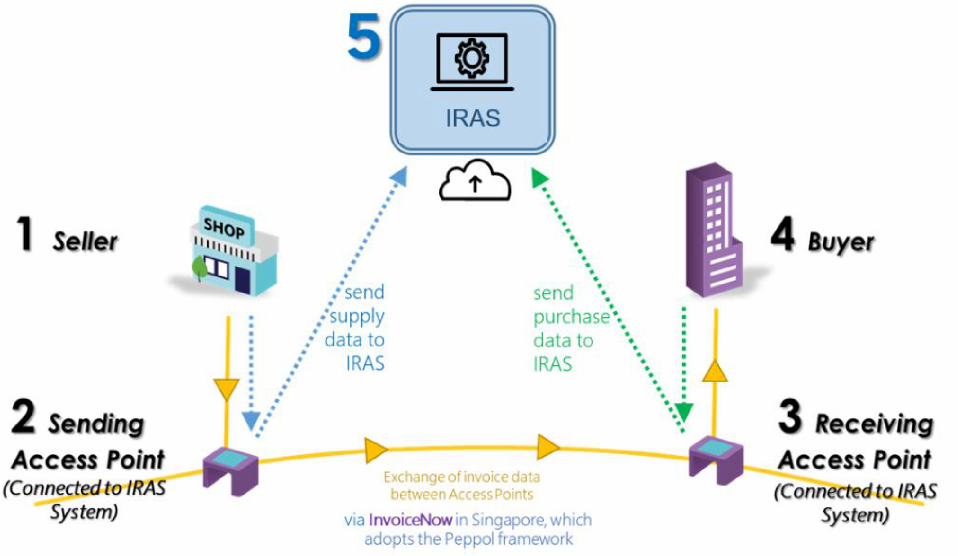
InvoiceNow extends the traditional four-corner e-delivery model to a 5th corner, integrating directly with the IRAS system for streamlined GST submissions. This comprehensive workflow ensures that invoice data flows efficiently and securely from seller to buyer, with a copy funneled to IRAS for regulatory purposes.
The workflow typically involves:
1. Seller: Initiates the process by sending supply data.
2. Sending Access Point (Connected to IRAS System): The seller’s Access Point transmits the invoice data. Invoice data is exchanged between the sending and receiving Access Points through the InvoiceNow network. Access Points act as accredited Peppol Service Providers by IMDA, facilitating the secure and standardized exchange of documents.
3. Receiving Access Point (Connected to IRAS System): The buyer’s Access Point receives the invoice data.
4. Buyer: Receives the purchase data.
5. IRAS: Copies of live invoices and extracted invoice data are funneled to the IRAS system, representing the crucial 5th corner.
Data Flow Types for Comprehensive Transaction Management
InvoiceNow accommodates various data flow types to cover both Accounts Receivable (AR) and Accounts Payable (AP) scenarios, ensuring a holistic approach to digital invoicing.
1. Accounts Receivable (AR)
For businesses issuing invoices and credit notes to their customers, InvoiceNow supports different transmission types:
- Flow Type A (Peppol Sending): Businesses send invoices and credit notes directly via the Peppol network, ensuring a structured digital format.
- Flow Type B (Non-Peppol Sending): For customers not on the Peppol network, businesses can still send invoices and credit notes through traditional channels, with the data aggregated and recorded in the Invoice System for eventual submission to IRAS.
- Flow Type C (Cash Register/POS Devices): This scenario covers sales transactions made through cash registers or Point-of-Sale (POS) devices, where data is aggregated before being recorded in the Invoice System.
2. Accounts Payable (AP)
For businesses receiving purchase invoices and credit notes from their suppliers:
- Flow Type D (Peppol Receiving): Businesses receive purchase invoices and credit notes directly from suppliers via the Peppol network.
- Flow Type E (Non-Peppol Receiving): For suppliers not utilizing the Peppol network, businesses receive invoices through alternate methods, with the data then recorded in their Invoice System.
- Flow Type F (Petty Cash Purchases): This addresses scenarios where businesses make petty cash purchases, and the aggregated data is recorded in the Invoice System.
Both Peppol and Non-Peppol transmission types are ultimately sent to IRAS servers via an Access Point, ensuring comprehensive data submission. The standard format for Peppol documents is BIS or PINT.
Mandatory Data Elements for InvoiceNow Compliance
To ensure seamless processing and compliance with IRAS requirements, invoices and credit notes transmitted via InvoiceNow must include specific mandatory data elements. These elements cover details about the seller, buyer, and the invoice/credit note itself.
| Seller Details | Buyer Details |
| Supplier Endpoint ID | Customer Endpoint ID |
| Supplier Scheme ID | Customer Scheme ID |
| Supplier UEN | Customer UEN |
| Supplier GSTIN | Customer Name |
| Supplier Name | Customer Address (Address Line 1, Postal Code, Country Code) |
| Supplier Address (Address Line 1, Postal Code, Country Code) |
| Invoice Details | |
| Customization ID | Item Net Price excluding GST |
| Profile ID | Item GST Category Code |
| Doc UUID (Unique Invoice Identifier) | Item GST Category Rate |
| Invoice Number | Invoice Line Net Amount |
| Invoice Date | Sum of Invoice Line Net Amount |
| Invoice Type Code (e.g., invoice or credit note) | Subtotal GST Category Amount |
| Invoice Currency Code | Subtotal GST Category Taxable Amount |
| GST Category Code (e.g., GST tax model) | Subtotal GST Category Rate |
| GST Category Rate (e.g., GST rate for the tax code) | Total GST Amount |
| Invoice Line Identifier | Total Invoice Amount without GST |
| Item Name | Total Invoice Amount with GST |
| Unit | Amount due for Payment |
| Quantity | |
*For non-SGD invoices, sgdtotal-excl-gst and sgdtotal-incl-gst are also required.
Similar mandatory fields apply to credit notes, ensuring consistency and full traceability.
| Credit Note Details | |
| Customization ID | Item Net Price, excluding GST |
| Profile ID | Item GST Category Code |
| Doc UUID (Unique invoice Identifier) | Item GST Category Rate |
| Credit Note Number | Credit Note Line Net Amount |
| Credit Note Date | Sum of Credit Note Line Net Amount |
| Invoice Type Code (i.e., invoice or credit note) | Total GST Amount |
| Credit Note Currency Code | Total Credit Note Amount without GST |
| GST Category Code (i.e., GST tax code) | Total Credit Note Amount with GST |
| GST Category Rate (i.e., GST rate for the tax code) | Amount due for Payment |
| Credit Note Line Identifier | Preceding Invoice number |
| Item Name | Preceding Invoice issue date |
| Unit | Invoice Note |
| Quantity | |
Axxis SAP B1 Singapore InvoiceNow Add-on: Bridging the Gap
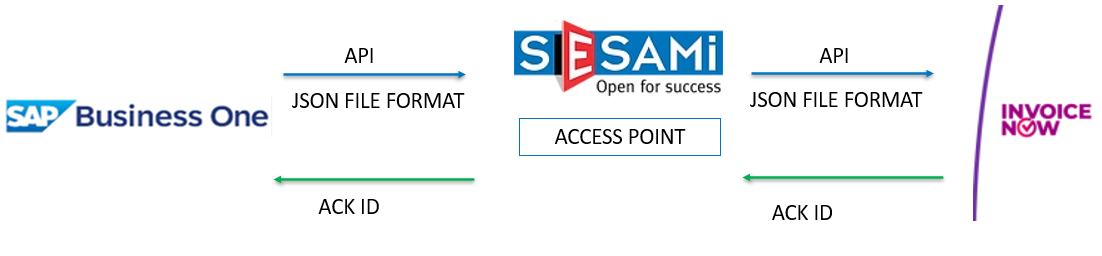
For businesses utilizing SAP Business One, specialized add-ons like the Axxis SAP B1 Singapore InvoiceNow Add-on play a crucial role in facilitating seamless integration with the InvoiceNow network. This add-on connects your SAP B1 system directly with an IMDA-accredited Access Point provider using APIs (Application Programming Interfaces) such as SESAMi for InvoiceNow.
Benefits of the Axxis SAP B1 InvoiceNow Add-on
1. Compliance: Ensures continuous compliance with the latest IMDA guidelines.
2. Comprehensive Data Capture: Consists of all necessary fields required by IRAS for accurate data submission.
3. Seamless Data Extraction: Efficiently extracts all necessary information from SAP B1, minimizing manual data preparation.
4. Flexible Upload Options: Supports both individual and batch uploads to the IMDA Portal.
5. C5 Network Integration: Enables activation of connection to the C5 Network, which funnels data to IRAS. This connection can be activated or deactivated as needed.
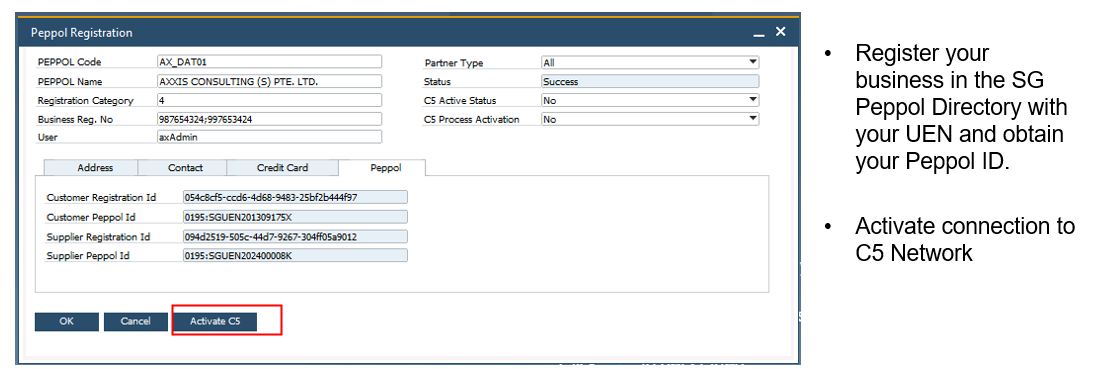
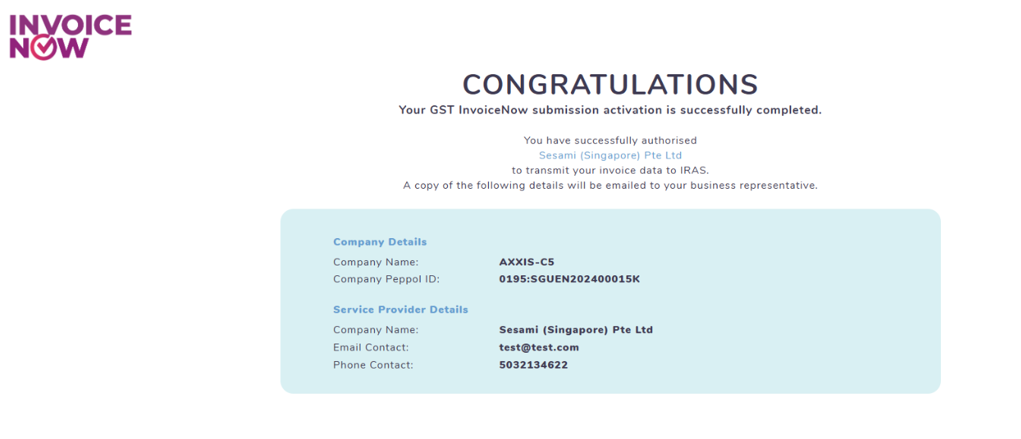
Successful Activation of C5 in Axxis InvoiceNow Addon:
Operational Workflow with the InvoiceNow Add-on
Axxis Consulting offers a structured operational workflow with the B1 InvoiceNow add-on solution, streamlining the process of sending and receiving invoices and credit notes. It can be seamlessly implemented into your existing system with minimal disruption. Schedule an appointment with us to explore how it works for your business.
Conclusion
At Axxis Consulting, we don’t just provide software; we provide expertise. As a leading SAP Platinum Partner in Singapore, we have helped hundreds of businesses navigate the complexities of digital transformation. Our consultants stay at the forefront of IMDA regulations, ensuring that our InvoiceNow Add-on remains the most reliable bridge between SAP Business One and the Peppol network. We understand the nuances of Singapore’s tax environment, making us a trusted partner for your compliance journey.
The roadmap to 2031 may seem long, but the operational advantages of InvoiceNow are available now. By adopting early, you claim government grants, streamline your internal finance workflows, and present your business as a modern, reliable partner to your vendors.