




For many businesses across Singapore and Malaysia, SAP Business One has been the ERP system that powers everyday operations. From finance and procurement to inventory, sales, manufacturing, and customer management, it has helped thousands of SMEs improve efficiency, gain better visibility, and grow with confidence.
However, businesses don’t stand still.
As organizations expand into new markets, operate across multiple entities, adopt artificial intelligence (AI), embrace cloud technologies, and respond to evolving regulatory requirements such as InvoiceNow (Peppol) in Singapore and LHDN e-Invoicing in Malaysia , many begin asking an important question:
Is it time to move from?
For many businesses, the answer isn’t about replacing a system that no longer works. Instead, it’s about adopting an ERP platform that can support the next stage of growth.
SAP GROW is SAP’s cloud ERP offering built on SAP S/4HANA Cloud Public Edition. It combines proven business best practices, embedded AI, real-time analytics, continuous innovation, and cloud scalability to help growing businesses modernize with confidence. SAP positions it as the natural next step for organizations that have outgrown their existing ERP capabilities.
Whether you’re a manufacturer, distributor, trading company, or professional services firm, moving to SAP GROW is more than a technology upgrade. It’s an opportunity to transform how your business operates, scales, and competes in an increasingly digital economy.
In This Guide, We’ll Cover
In this comprehensive guide, you’ll learn:
- When it’s time to move beyond SAP Business One
- Why businesses are choosing SAP GROW
- The key differences between SAP Business One and SAP GROW
- The business benefits of SAP GROW
- How AI, automation, and SAP Business Technology Platform (SAP BTP) accelerate digital transformation
- How SAP GROW supports Singapore’s InvoiceNow (Peppol) and Malaysia’s LHDN e-Invoicing initiatives
- What a successful SAP Business One migration looks like
- Common migration challenges and how to avoid them
- Why choosing the right implementation partner matters
- How Axxis Consulting’s AI-CELERATE for SAP GROW Fast helps businesses accelerate cloud ERP adoption
By the end of this guide, you’ll have a clear understanding of whether your business is ready to transition to SAP GROW and how to make the move with confidence.
Why Businesses Are Moving Beyond SAP Business One
SAP Business One continues to be one of the world’s most trusted ERP solutions for small and midsize businesses. It delivers a strong operational foundation by integrating finance, sales, purchasing, inventory, production, and customer management into a single system.
For many organizations, it remains the right solution.
However, as businesses evolve, so do their requirements.
Companies that are expanding regionally, managing multiple legal entities, processing higher transaction volumes, or embracing digital transformation often discover that their ERP needs have changed significantly since they first implemented SAP Business One.
Rather than replacing SAP Business One because it has failed, these businesses are building on the strong foundation it has already established.
According to SAP, organizations typically begin evaluating SAP Cloud ERP when business complexity increases and future growth requires greater scalability, automation, and innovation.
Today, several market trends are accelerating this shift.
Businesses are increasingly investing in AI, automation, cloud technologies, and real-time analytics to improve productivity and remain competitive. At the same time, security, compliance, and operational resilience have become key priorities when selecting an ERP platform. SAP’s SME market research highlights these as major drivers of cloud ERP adoption among growing businesses.
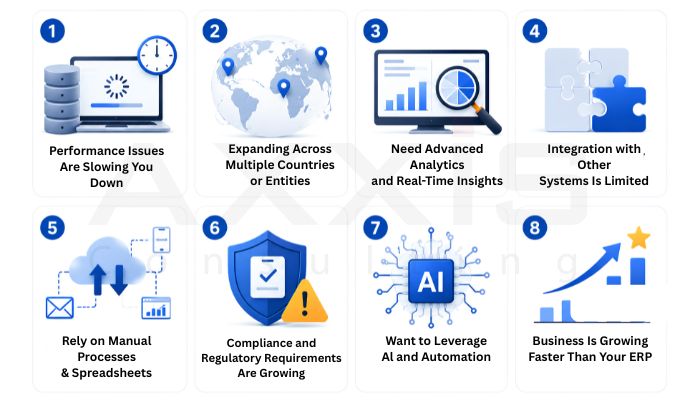
8 Signs Your Business Has Outgrown SAP Business One
Every business grows at its own pace. However, there are several common indicators that suggest it may be time to consider SAP GROW.
1. Your Business Is Expanding Across Multiple Entities or Countries
Operating in multiple countries introduces new levels of complexity.
You may need to manage:
- Multiple legal entities
- Multiple currencies
- Different tax regulations
- Regional financial reporting
- Intercompany transactions
- Consolidated financial statements
For businesses operating across Singapore, Malaysia, and the wider ASEAN region, managing these processes efficiently becomes increasingly important.
SAP GROW provides standardized global business processes while supporting local business requirements, making regional expansion significantly easier.
2. Your Teams Spend Too Much Time on Manual Processes
Manual approvals, spreadsheet-based reporting, duplicate data entry, and disconnected workflows reduce productivity and increase the likelihood of errors.
As transaction volumes grow, these inefficiencies become more costly.
SAP GROW helps automate repetitive business processes through intelligent workflows and embedded AI, allowing employees to focus on strategic work instead of administrative tasks.
3. Decision-Makers Don’t Have Real-Time Visibility
Modern businesses need answers immediately—not days later.
Executives want to understand:
- Cash flow
- Profitability
- Inventory levels
- Sales performance
- Production efficiency
- Customer demand
SAP GROW provides embedded analytics and real-time dashboards directly within business processes, enabling faster and more informed decision-making.
4. Your IT Team Spends More Time Maintaining Systems Than Driving Innovation
Traditional on-premise environments often require ongoing server maintenance, software upgrades, backups, security patches, and infrastructure management.
These responsibilities consume valuable IT resources.
Because SAP GROW is cloud-based, SAP manages the underlying infrastructure and delivers continuous innovation updates. As a result, your IT team can focus on initiatives that create business value rather than maintaining systems.
5. You Want to Leverage AI Across Your Business
Artificial intelligence has rapidly moved from being a competitive advantage to a business necessity.
Growing businesses are increasingly using AI to:
- Automate routine work
- Improve forecasting
- Detect anomalies
- Generate business insights
- Enhance productivity
- Support faster decision-making
Unlike standalone AI tools, SAP GROW embeds AI directly into business processes, helping users work more efficiently without leaving the ERP system.
SAP’s market research also shows that AI investment continues to accelerate among SMBs, making intelligent ERP a key priority for future growth.
6. Compliance Requirements Are Becoming More Complex
Businesses today must respond quickly to changing regulatory requirements.
For organizations operating in Singapore and Malaysia, initiatives such as InvoiceNow (Peppol) and LHDN e-Invoicing are encouraging companies to modernize financial processes and improve digital connectivity.
A modern cloud ERP helps organizations remain agile while adapting to evolving compliance requirements.
7. You Need Better Integration Across Business Applications
Today’s organizations rely on many digital solutions, including CRM, eCommerce, warehouse management, payroll, manufacturing execution systems (MES), logistics platforms, and third-party applications.
When these systems operate independently, employees spend valuable time transferring data manually.
SAP GROW, together with SAP Business Technology Platform (SAP BTP) , enables seamless integration between SAP and third-party applications while keeping the ERP core clean and ready for future innovation.
8. You’re Planning for Long-Term Growth
Perhaps the most important reason businesses move to SAP GROW isn’t because they have reached a limitation today.
It’s because they are preparing for tomorrow.
Organizations investing in cloud ERP today position themselves to embrace AI, automation, continuous innovation, and future business expansion without repeatedly replacing core business systems.
What Is SAP GROW?
SAP GROW is SAP’s cloud ERP offering designed specifically for growing businesses that want to adopt SAP S/4HANA Cloud Public Edition quickly and confidently.
More than just ERP software, SAP GROW combines:
- SAP S/4HANA Cloud Public Edition
- Industry best practices
- Guided implementation methodology
- Continuous innovation
- Embedded AI capabilities
- SAP Business Technology Platform (SAP BTP)
- Learning resources and adoption services
Unlike traditional ERP implementations that often require extensive customization and lengthy deployment cycles, SAP GROW is designed around standardized best practices. This approach enables businesses to adopt modern cloud ERP faster while remaining flexible enough to support industry-specific requirements.
Instead of asking businesses to build everything from scratch, SAP GROW provides a proven framework that accelerates implementation, reduces project risk, and helps organizations realize business value sooner.
SAP Business One vs SAP GROW
Both SAP Business One and SAP GROW are excellent ERP solutions—but they are designed for different stages of business growth.
| Feature | SAP Business One | SAP GROW |
|---|---|---|
| Deployment | On-premise or Cloud | Cloud-native |
| ERP Platform | SAP Business One | SAP S/4HANA Cloud Public Edition |
| Target Business | Small and midsize businesses | Growing businesses preparing for long-term scale |
| AI Capabilities | Limited | Embedded AI and Joule |
| Analytics | Standard reporting | Real-time embedded analytics |
| Updates | Scheduled upgrades | Continuous innovation from SAP |
| Infrastructure | Customer managed | SAP managed |
| Integration | Standard integrations | SAP Business Technology Platform (SAP BTP) |
| Scalability | Suitable for current operations | Designed for regional and global growth |
The decision isn’t about which ERP is better.
It’s about choosing the ERP that best supports your business today—and tomorrow.
For businesses that continue operating successfully within their current scope, SAP Business One remains an excellent solution.
However, organizations planning regional expansion, digital transformation, AI adoption, or more complex operations often find SAP GROW better aligned with their long-term strategy.
Why Businesses Choose SAP GROW
1. A Future-Ready Cloud ERP
Technology evolves rapidly.
Instead of investing in periodic ERP upgrades, businesses using SAP GROW receive continuous innovation from SAP through regular cloud updates.
This means your ERP stays current without disruptive upgrade projects, allowing your organization to adopt new capabilities as they become available.
2. Embedded AI That Works Within Your Business Processes
AI delivers the greatest value when it’s integrated into daily work—not when it’s a separate tool.
SAP GROW includes embedded AI capabilities and Joule , SAP’s AI copilot, to help employees work more efficiently across business functions.
Examples include:
- Automating repetitive administrative tasks
- Accelerating financial reconciliations
- Generating business insights
- Improving forecasting accuracy
- Supporting procurement decisions
- Helping users find information faster
Because AI is embedded directly into SAP processes, employees spend less time switching between systems and more time making informed decisions.
3. Real-Time Analytics for Faster Decisions
Business leaders need immediate access to accurate information.
Instead of waiting until the end of the week—or month—for reports, SAP GROW provides live dashboards and embedded analytics across finance, sales, procurement, inventory, manufacturing, and supply chain operations.
With a single source of truth, leaders can respond faster to changing market conditions and customer demands.
4. Standardized Best Practices
Every business wants flexibility.
However, excessive customization often increases implementation costs and makes future upgrades more difficult.
SAP GROW takes a different approach.
It provides preconfigured best-practice business processes developed from thousands of successful SAP implementations worldwide. Businesses can adopt these proven processes while extending capabilities through SAP Business Technology Platform (SAP BTP) when needed.
This “clean core” strategy helps organizations innovate without creating unnecessary technical debt.
What Is SAP Business Technology Platform (SAP BTP)?
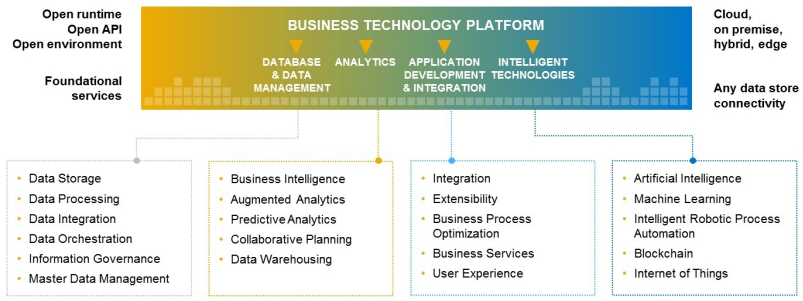
One of the biggest advantages of SAP GROW is its close integration with SAP Business Technology Platform (SAP BTP) .
Think of SAP BTP as the innovation layer that sits alongside your ERP.
Instead of customizing the ERP core, businesses can use SAP BTP to build extensions, automate workflows, integrate third-party applications, and develop AI-powered solutions while keeping the core ERP clean and easy to maintain.
With SAP BTP, organizations can:
- Connect SAP and non-SAP applications
- Build custom business applications
- Automate workflows
- Integrate manufacturing systems
- Connect CRM and eCommerce platforms
- Develop AI-powered solutions
- Create business dashboards
- Support country-specific compliance requirements
This approach allows businesses to innovate continuously without compromising future SAP upgrades.
Why SAP GROW Matters for Businesses in Singapore & Malaysia
Digital transformation is accelerating across Southeast Asia.
Businesses are expanding across borders, modernizing operations, and responding to increasingly digital regulatory requirements.
For organizations in Singapore and Malaysia, cloud ERP is no longer just about improving operational efficiency—it also supports regulatory readiness, business resilience, and regional growth.
Singapore: Supporting InvoiceNow (Peppol)
Singapore continues to drive digital transformation through InvoiceNow , the national e-invoicing initiative based on the Peppol network.
InvoiceNow enables businesses to exchange structured electronic invoices directly between ERP systems, reducing manual data entry, improving accuracy, and shortening payment cycles.
As adoption continues to grow, organizations are increasingly looking for ERP solutions that integrate seamlessly with digital invoicing processes.
SAP GROW provides a modern cloud ERP foundation that can support these evolving requirements through SAP’s localization capabilities and SAP BTP-based integrations.
Malaysia: Preparing for LHDN e-Invoicing
Malaysia is also undergoing a significant digital transformation with the nationwide rollout of LHDN e-Invoicing .
Businesses must generate, validate, and submit electronic invoices in accordance with Inland Revenue Board (LHDN) requirements.
Rather than treating e-Invoicing as a standalone compliance project, many organizations are using it as an opportunity to modernize their ERP systems.
With SAP GROW, businesses gain a cloud ERP platform that supports digital finance processes and can integrate with local e-Invoicing solutions through SAP BTP, helping organizations remain compliant while improving operational efficiency.
Managing Regional Growth with Confidence
Many businesses headquartered in Singapore or Malaysia are expanding across ASEAN.
Managing multiple entities, currencies, tax jurisdictions, and reporting requirements becomes increasingly complex as organizations grow.
SAP GROW helps businesses standardize processes across subsidiaries while maintaining local compliance and financial visibility.
This creates a single source of truth across the organization, making regional expansion more efficient and easier to manage.
Is Your Business Ready for SAP GROW?
While every organization is different, businesses often consider SAP GROW when they want to:
- Expand into multiple countries or regions
- Manage multiple legal entities
- Improve visibility across finance, sales, procurement, and operations
- Adopt AI and intelligent automation
- Replace manual reporting with real-time analytics
- Strengthen compliance and governance
- Integrate multiple business applications
- Reduce IT infrastructure management
- Build a scalable platform for long-term growth
If several of these goals align with your business strategy, it may be the right time to evaluate whether SAP GROW can support your next phase of growth.
How to Migrate from SAP Business One to SAP GROW
Migrating to a new ERP may seem like a significant undertaking. However, with proper planning, the right implementation methodology, and an experienced SAP partner, it can become a structured journey that minimizes disruption while maximizing business value.
Rather than viewing migration as simply moving data from one system to another, think of it as an opportunity to modernize your business processes, improve operational efficiency, and build a scalable foundation for future growth.
SAP recommends a phased, best-practice approach that helps organizations adopt SAP GROW with greater confidence while reducing project risk.
A Typical SAP Business One Migration Journey
A successful migration typically follows these stages:
| Phase | Objective |
|---|---|
| 1. Discovery & Assessment | Evaluate your current SAP Business One environment, business goals, and implementation scope. |
| 2. Business Process Review | Identify opportunities to standardize and optimize workflows using SAP best practices. |
| 3. Data Preparation | Cleanse, validate, and prepare master and transactional data for migration. |
| 4. System Configuration | Configure SAP GROW based on your agreed implementation scope and industry requirements. |
| 5. Data Migration & Integration | Migrate data and integrate SAP GROW with other business applications where required. |
| 6. Testing & User Acceptance | Validate business processes, integrations, and user readiness before go-live. |
| 7. Training & Change Management | Equip users with the knowledge and confidence to adopt the new ERP successfully. |
| 8. Go-Live & Continuous Improvement | Launch SAP GROW and continuously optimize processes as your business evolves. |
This phased methodology helps reduce implementation risks while enabling your organization to realize value faster.
Common Migration Challenges and How to Overcome Them
Every ERP migration presents unique challenges. Fortunately, most can be addressed with proper planning and the right expertise.
Data Quality Issues
Over time, duplicate records, inconsistent master data, and outdated information can accumulate in any ERP system.
Before migrating, businesses should:
- Remove duplicate records
- Archive obsolete data
- Standardize master data
- Review customer and supplier information
- Validate financial records
Starting with clean, accurate data improves reporting, automation, and decision-making in your new ERP environment.
Trying to Replicate Every Customization
Many organizations assume every customization from SAP Business One must be recreated.
In reality, this often increases costs and project complexity.
Instead, businesses should evaluate whether those customizations are still required. SAP GROW includes modern best-practice processes that may already deliver the desired outcomes without additional development.
When extensions are necessary, SAP Business Technology Platform (SAP BTP) enables organizations to build them while keeping the ERP core clean and easier to maintain.
User Adoption
Technology alone doesn’t drive transformation—people do.
Employees need to understand not only how to use the new system but also why the change benefits their daily work.
Successful implementations typically include:
- Early stakeholder engagement
- Structured training
- Hands-on workshops
- Clear communication
- Ongoing post-go-live support
Strong change management significantly improves user adoption and long-term success.
Underestimating Future Growth
Some organizations implement ERP based solely on today’s requirements.
However, ERP projects should support the next five to ten years of business growth.
When designing your SAP GROW solution, consider future plans such as:
- Regional expansion
- New product lines
- Additional subsidiaries
- Manufacturing growth
- AI adoption
- Business acquisitions
Planning ahead reduces future implementation costs and avoids unnecessary rework.
SAP Tools That Simplify Migration
SAP provides several tools and accelerators to help organizations transition from SAP Business One to SAP GROW more efficiently.
These include:
- Digital Discovery Assessment (DDA) to evaluate your current ERP landscape and recommend an implementation scope.
- Migration accelerators that help extract, transform, and load data into SAP GROW.
- SAP Activate methodology , which provides a proven implementation framework based on best practices and agile delivery.
- Preconfigured business processes designed to accelerate deployment and reduce implementation complexity.
Together, these tools help organizations shorten implementation timelines while reducing project risks.
Why Choosing the Right SAP Partner Matters
Selecting the right implementation partner is just as important as choosing the right ERP solution.
An experienced SAP partner brings more than technical expertise—they provide strategic guidance, industry knowledge, and proven methodologies that help ensure project success.
The right partner will:
- Align your ERP strategy with your business goals
- Recommend industry best practices
- Minimize implementation risks
- Support user adoption and change management
- Accelerate time-to-value
- Provide ongoing optimization after go-live
Ultimately, your implementation partner should help you achieve measurable business outcomes—not simply deploy software.
Why Businesses Choose Axxis Consulting
Migrating to SAP GROW is a strategic investment, and choosing the right implementation partner can make all the difference.
For more than two decades, Axxis Consulting has helped businesses across Singapore and Malaysia modernize their operations with SAP solutions. As an SAP Platinum Partner , Axxis combines deep technical expertise with industry knowledge to deliver successful ERP projects that create long-term business value.
Organizations choose Axxis Consulting because of its:
- Extensive SAP expertise across SAP Business One, SAP GROW, SAP S/4HANA Cloud Public Edition, SAP Business Technology Platform (SAP BTP), SAP Business AI, and SAP Business Data Cloud.
- Industry specialization in manufacturing, wholesale distribution, trading, professional services, and other growing businesses.
- Local expertise in Singapore and Malaysia, including support for InvoiceNow (Peppol), LHDN e-Invoicing, and country-specific business requirements.
- Regional delivery capability , backed by offices in Singapore and Malaysia and access to global expertise through the United VARs alliance.
- Proven implementation methodology , helping businesses reduce project risks and accelerate time-to-value.
- End-to-end services , from business process assessment and implementation to training, managed support, and continuous optimization.
Whether you’re evaluating cloud ERP for the first time or planning your migration from SAP Business One, Axxis Consulting works alongside your team to ensure a smooth, structured transition with measurable business outcomes.
Accelerate Your ERP Journey with AI-CELERATE for SAP GROW Fast
Every business wants to realize the value of its ERP investment as quickly as possible.
That’s why Axxis Consulting offers AI-CELERATE for SAP GROW Fast —an accelerated implementation approach designed to help businesses adopt SAP GROW with greater speed, confidence, and predictability.
Built on SAP best practices, AI-CELERATE combines predefined implementation scope, industry expertise, and AI-powered capabilities to streamline deployment while reducing project complexity. By following a structured implementation methodology, businesses can shorten time-to-value, minimize disruption, and begin benefiting from SAP GROW sooner.
Beyond implementation, AI-CELERATE also helps organizations embrace AI from day one, enabling users to improve productivity through intelligent automation, guided search, embedded insights, and streamlined business processes.
Instead of spending months defining every process from scratch, businesses can adopt proven best practices while retaining the flexibility to innovate as they grow.
Learn more about AI-CELERATE for SAP GROW Fast and discover how Axxis Consulting can accelerate your cloud ERP journey.
Success Starts with the Right Foundation
Migrating to SAP GROW is more than a technology upgrade—it’s an opportunity to modernize your business for the future.
Businesses that adopt cloud ERP gain more than improved efficiency. They position themselves to leverage AI, automate operations, strengthen compliance, improve collaboration, and respond more quickly to changing market conditions.
The sooner your ERP supports your future ambitions, the sooner your business can focus on innovation instead of operational limitations.
Frequently Asked Questions
No. SAP Business One remains an important ERP solution for many small and midsize businesses. SAP GROW is designed for organizations that require greater scalability, continuous innovation, embedded AI, and cloud-native capabilities as they grow.
You should consider SAP GROW if your business is expanding across multiple entities or countries, requires more advanced analytics, wants to adopt AI, needs stronger integration capabilities, or is preparing for long-term digital transformation.
The timeline depends on factors such as business complexity, implementation scope, data quality, integrations, and user readiness. Working with an experienced implementation partner helps accelerate deployment while reducing project risks.
Yes. SAP provides migration tools and methodologies to help organizations migrate master data and relevant transactional data to SAP GROW while maintaining business continuity.
Yes. Through SAP Business Technology Platform (SAP BTP), SAP GROW can integrate with SAP and non-SAP applications, including CRM, eCommerce, manufacturing systems, payroll, logistics platforms, and industry-specific solutions.
Absolutely. SAP GROW includes industry best practices that support manufacturing, wholesale distribution, trading, and professional services businesses looking to improve operational efficiency and scale with confidence.
Ready to Take the Next Step?
Your ERP should do more than support your business today—it should prepare you for what’s next.
If you’re expanding into new markets, embracing AI, modernizing operations, or planning for long-term growth, SAP GROW provides the cloud ERP foundation to help your business scale with confidence.
The journey from SAP Business One to SAP GROW doesn’t have to be complex. With the right strategy, proven methodology, and experienced implementation partner, you can modernize your operations while minimizing disruption and maximizing business value.
At Axxis Consulting , we help businesses across Singapore and Malaysia assess their ERP readiness, develop a tailored migration roadmap, and successfully implement SAP GROW. From initial planning through go-live and ongoing optimization, our team is committed to helping you achieve a successful digital transformation.