



Choosing an ERP system ranks among the most consequential technology decisions a business will make. Whether you run a 5-person company or a global enterprise, the right ERP system changes how your entire organization operates.
If your team still juggles disconnected finance and operations data, wrestles with manual reconciliations, or relies on spreadsheets that can’t keep up, you’ve likely outgrown your current setup — no matter your company size.
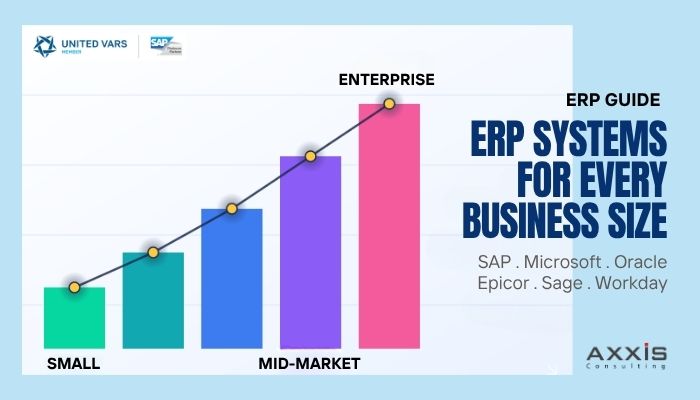
This guide compares the leading ERP systems across the full size spectrum, from small businesses to large enterprises, including Microsoft, Oracle, Epicor, Sage, Workday, and SAP.
Instead of assuming one company profile fits all, we’ll map each vendor to where it performs best. That way, you can identify not just today’s right fit, but a platform that will grow with you — including considerations specific to companies operating in Singapore and Malaysia.
As an SAP Platinum Partner that has guided businesses across manufacturing, distribution, and professional services through ERP selection and implementation in Singapore and Malaysia, Axxis Consulting built this comparison from firsthand project experience, not just vendor marketing material. We’ve seen which factors actually determine implementation success, and we’ll walk through them here.
What Is an ERP System?
An ERP (Enterprise Resource Planning) system unifies your core business functions including finance, supply chain, inventory, procurement, HR, and reporting into a single connected platform.
Rather than managing these functions across separate tools or spreadsheets, an ERP system gives your business one source of truth for its data. It automates routine processes, and it delivers real-time visibility into operations so you can make faster, better-informed decisions.
ERP System Comparison Table
| Vendor | Product | Key Differentiators | Best For |
|---|---|---|---|
| Microsoft | Dynamics 365 Finance and Supply Chain | Deep Microsoft ecosystem integration (Teams, Power Platform, Copilot), modular licensing, fast deployment | Upper midmarket to large enterprises, broad industry coverage |
| Oracle | Fusion Cloud ERP | Comprehensive suite across finance, SCM, and EPM; embedded GenAI and ML; quarterly updates | Medium to large enterprises, 25+ industries |
| Oracle | NetSuite | Unified cloud suite (ERP, CRM, HCM); SuiteSuccess preconfigured workflows; highly customizable | Pre-revenue to $1B revenue businesses, high-growth SMEs |
| Epicor | Industry ERP Cloud | Modular, composable platform; hybrid deployment; deep vertical focus | Manufacturing, distribution, retail, automotive ($10M–$1B revenue) |
| Sage | Intacct | Strong financials and reporting, robust APIs, AICPA preferred partner | Businesses with 20–1,000 employees; accountants, healthcare, nonprofit |
| Workday | Workday ERP | Unified finance, HR, and planning; AI-driven automation | Medium to large enterprises; finance, HR, professional services |
| SAP | Business One | Flexible cloud/on-prem deployment, user-friendly interface, partner-driven industry solutions | Businesses up to 100 employees |
| SAP | S/4HANA Cloud | Integrated end-to-end suite, embedded AI and predictive analytics, strong brand recognition | Small, medium, and large enterprises across all industries |
Vendor Breakdown
1. Microsoft Dynamics 365
Dynamics 365 Finance and Supply Chain builds on deep integration with the Microsoft ecosystem — Teams, Power Platform, Fabric, and Copilot AI. Consequently, it’s a natural fit if your organization already runs on Microsoft tools. The platform offers modular, scalable licensing based on user, device, or transaction volume, and it supports rapid deployment across more than 200 countries with 51+ localizations. As a result, global or acquisitive companies tend to gravitate toward it.
2. Oracle Fusion Cloud ERP & NetSuite
Oracle actually offers two distinct products, and the right one depends on your company’s stage. Fusion Cloud ERP delivers a comprehensive suite spanning finance, supply chain, and enterprise performance management, with embedded generative AI, machine learning, and quarterly innovation cycles. This makes it well-suited for medium to large enterprises across 25+ industries. NetSuite, on the other hand, serves earlier-stage and high-growth businesses — from pre-revenue startups up through companies approaching $1B in revenue. Its SuiteSuccess methodology bundles industry-specific best practices and preconfigured workflows, which speeds up implementation considerably.
3. Epicor Industry ERP Cloud
Epicor takes a different approach: it differentiates through vertical depth rather than broad horizontal coverage. Its modular, composable platform supports cloud, on-premise, or hybrid deployment, and it particularly excels for manufacturing, distribution, retail, and automotive businesses. Epicor Grow, the platform’s low-code/no-code BI tool, also adds self-service reporting without pulling in heavy IT involvement. Because of this flexibility, the platform scales comfortably from $10M to $1B in revenue.
4. Sage Intacct
Sage Intacct centers on financial management and reporting strength above all else. It offers robust APIs and easy integrations, and it holds AICPA preferred-partner status — so accounting-led organizations often choose it first. The platform targets businesses with 20 to 1,000 employees and shows particular traction in construction, healthcare, nonprofit, SaaS, and manufacturing. Moreover, Sage continues expanding its manufacturing and construction capabilities, so this fit will likely strengthen further.
5. Workday ERP
Workday extends well beyond a traditional ERP system by unifying finance, HR, planning, and analytics on one platform. It also layers in AI-driven automation for tasks like journal anomaly detection and invoice processing. With more than 10,000 customers and over half of the Fortune 500 running on the platform, Workday clearly targets medium to large enterprises — particularly in finance, HR, professional services, healthcare, and education. Notably, it also supports fast M&A integration, which matters if you’re actively acquiring companies.
6. SAP Business One & S/4HANA Cloud
SAP covers very different ends of the market through two distinct products. SAP Business One serves smaller businesses — typically up to 100 employees and offers flexible cloud or on-premise deployment, a user-friendly interface, easy integrations (including with Salesforce), and industry-specific solutions delivered through SAP’s partner network.
SAP S/4HANA Cloud, meanwhile, delivers an integrated end-to-end suite built for small, medium, and large enterprises across all industries, backed by embedded AI, predictive analytics, and SAP’s strong brand recognition and financial expertise.
For businesses in Singapore and Malaysia, this range matters enormously: a company can start on SAP Business One as a small business, then grow into SAP S/4HANA Cloud as a large enterprise, all without switching ecosystems. That continuity gives SAP a real advantage over vendors that force a platform change somewhere along your growth path.
How to Choose the Right ERP System
Several factors should drive your decision — far more than brand recognition alone:
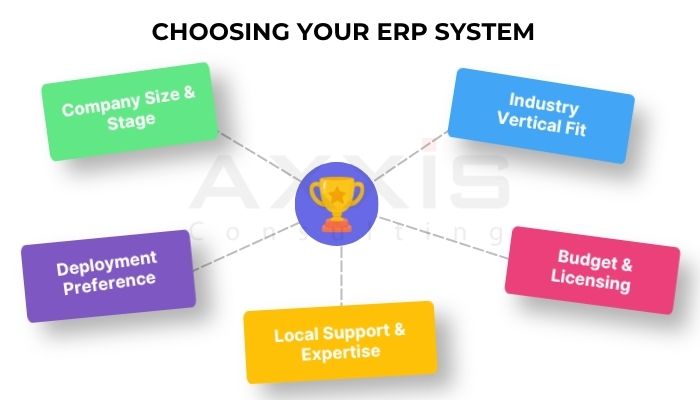
- Company size and revenue stage. SAP Business One and Sage Intacct suit smaller companies well; NetSuite and Dynamics 365 scale effectively with high growth; S/4HANA, Oracle Fusion, and Workday serve larger enterprises best.
- Industry vertical fit. Epicor leads in manufacturing and distribution; Sage Intacct performs strongly for accounting-led and nonprofit organizations; SAP offers broad, partner-delivered industry coverage across nearly every sector.
- Deployment preference. Cloud-only, on-premise, and hybrid options vary significantly from vendor to vendor, so clarify this early.
- Budget and licensing model. User-based, transaction-based, and tiered licensing each affect your total cost of ownership differently as you scale — run the numbers before you commit.
- Local support and implementation expertise. For businesses in Singapore and Malaysia specifically, partnering with an established local implementation team materially speeds up deployment and strengthens post-go-live support.
Ultimately, the best ERP system isn’t necessarily the one with the longest feature list. It’s the one that matches your size, industry, and growth trajectory today while leaving room to scale tomorrow.
Frequently Asked Questions
For small businesses — especially those with fewer than 100 employees — SAP Business One and Sage Intacct consistently stand out. Both offer easier deployment and lower complexity than enterprise-tier systems, which matters when your team lacks a large in-house IT department.
SAP Business One targets smaller businesses and offers a simpler, more affordable deployment. S/4HANA Cloud, by contrast, serves small, medium, and large enterprises and includes more advanced embedded AI and predictive analytics capabilities.
Cost varies widely depending on vendor, deployment model, and licensing structure (per-user, per-transaction, or tiered). Because of this variation, you should request a vendor-specific quote based on your company size and requirements rather than relying on general estimates.
Get a price quote for SAP Business One to see real numbers for your business.
SAP maintains a strong presence and partner network across Singapore and Malaysia. Business One and S/4HANA Cloud together cover businesses from small enterprises through large organizations, and local implementation and support partners back both products on the ground.
Implementation timelines depend on your company size, chosen product, and project scope. Smaller deployments like Business One can go live in just a few months, while enterprise-scale systems such as S/4HANA Cloud or Oracle Fusion typically require longer, phased rollouts.
Get Expert Guidance for Your ERP Selection
Choosing the right ERP system isn’t just about where your business stands today. It’s about whether your platform can carry you through your next stage of growth without forcing a disruptive switch. As an SAP Platinum Partner operating in Singapore and Malaysia, Axxis Consulting has helped businesses at every size from SAP Business One through SAP S/4HANA Cloud — evaluate their options and implement a solution built to grow with them.