


The economic landscape for Malaysian SMEs has shifted. Patchwork systems for accounting, inventory, and sales are no longer viable. The Inland Revenue Board of Malaysia (LHDN) e-invoicing mandate has permanently changed the rules, with Phase 4 regulating businesses turning over between RM1 million and RM5 million annually by early 2026.
Compliance is now mission-critical. While a relaxation period for consolidated invoicing exists until the end of 2026, relying on manual workarounds is dangerous. Read more about the LHDN e-Invoicing 2026 Update here.
Strict rules mandate real-time validation for B2B transactions over RM10,000, creating severe operational bottlenecks. To future-proof and eliminate friction, Malaysian SMEs must transition to automated, integrated ERP platforms.
This guide evaluates the market to help you choose the best ERP solution for 2026.
Why Basic Accounting Software Falls Short in 2026
Many small business owners initially look for the easiest, cheapest route to tax compliance. They often assume that downloading a quick software patch or subscribing to a basic local accounting app will solve the problem. Unfortunately, this approach introduces significant operational risks.
1. The Problem with Fragmented Systems
- Finance-Isolated Fixes: Patching a standalone accounting system only solves the problem for your finance team, leaving sales, warehouse, and procurement teams completely disconnected.
- Operational Friction: When a sales rep closes a high-value B2B deal, a fragmented environment forces the finance team to manually re-enter order and dispatch data into an accounting tool to push it to the LHDN portal.
- Risk Exposure: This duplicate data entry introduces human error, delays customer billing, and creates major discrepancies between actual warehouse stock and verified tax records.
2. Transitioning to True Automation
- Single Source of Truth: A comprehensive ERP platform unifies your entire business, removing departmental silos.
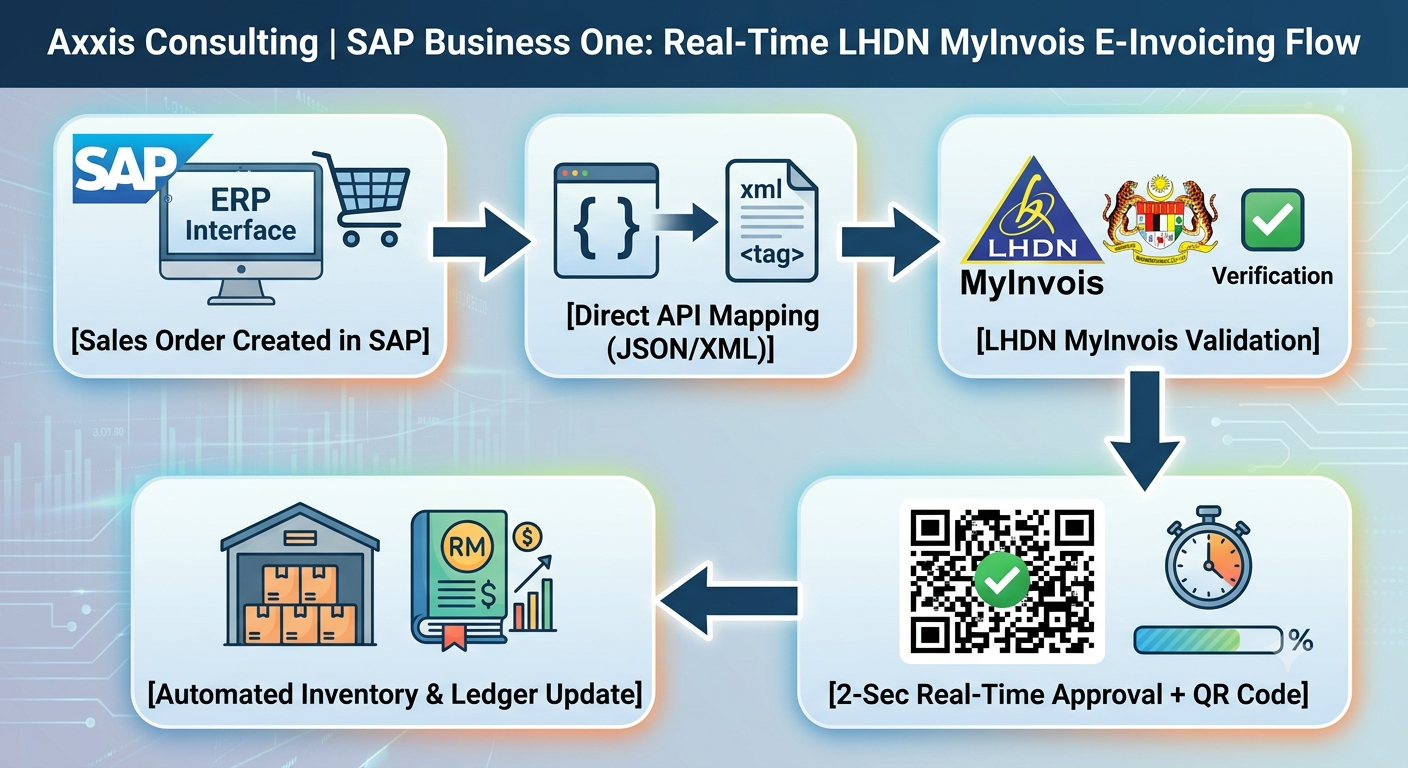
- Instant, Integrated Compliance: The moment a sales order matches a delivery note, the system instantly generates the compliant cryptographic data required by LHDN.
- Real-Time API Validation: The platform transmits data via an API, secures LHDN validation, and updates your inventory ledgers simultaneously within seconds.
- Strategic Growth: Upgrading to a unified ERP moves your business beyond just satisfying tax auditors, allowing you to scale your entire operation efficiently.
The 2026 Malaysian SME ERP Landscape: A Direct Comparison
Choosing the right platform requires a clear understanding of what different systems offer. To help you evaluate your options, we have analyzed the top competitors in the Malaysian market based on their localization depth, scalability, and LHDN API maturity.
| ERP Platform | Core Target Market | LHDN e-Invoicing Integration Mechanism |
Scalability & Operations | Best Business Fit |
| SAP Business One | Growing SMEs & Mid-Market (RM5m to RM100m+) |
Native Direct API Integration Layer. Automatically triggers 2-second real-time MyInvois validation, handles 72-hour cancellation loops, and prints embedded QR codes instantly. | Very High. Features advanced manufacturing, multi-currency tracking, multi-warehouse controls, and automated multi-company financial consolidation. |
Best for ambitious SMEs that want to completely automate tax compliance while scaling complex operations. |
| Odoo | Micro-to-Medium SMEs (RM1m to RM15m) |
Relies heavily on localized third-party partner applications and custom middleware patches. | Medium-High. Offers a highly modular app ecosystem, though continuous LHDN middleware compliance depends on the technical stability of your specific local partner. |
Best for smaller businesses prioritizing low initial software licensing costs over native tier-one architecture. |
| Oracle NetSuite | Mid-Market to Enterprise | Requires suite-integrated localization modules or custom middleware configurations. | High. Provides a capable, cloud-native global ERP framework, but local Malaysian updates often require substantial custom development budgets. |
Best for fast-growing tech startups or multinational service firms with large capital reserves. |
| AutoCount / SQL Account | Micro & Mass Small Market (Under RM5m) |
Traditional localized accounting software updated with automated e-invoicing patches. | Low-Medium. Highly effective for simple local bookkeeping and standard payroll, but struggles with complex supply chains or international scaling. |
Best for straightforward trading, retail, or service businesses with basic, non-complex operations. |
Also Read the comparison blogs:
👉Upgrading from MYOB to an ERP System
👉SAP Business One vs. Odoo
👉Step Up from SQL Accounting to SAP Business One
👉SAP Business One Vs. Sage
👉SAP Business One vs NetSuite for SMEs
👉Why Upgrade from UBS to SAP Business One
👉Autocount vs SAP Business One – When to Upgrade?
👉Upgrading from Simple Accounting Software
Deep Dive: Why SAP Business One is the Definitive ERP for Malaysian SMEs
As an established global leader in enterprise software, SAP designed SAP Business One specifically to give growing SMEs the exact same operational discipline that Fortune 500 companies enjoy.
When it comes to local market compliance, SAP does not rely on third-party workarounds. Instead, it embeds Malaysian tax laws directly into its core financial architecture.
1. Seamless Continuous Transaction Control (CTC)
SAP Business One features a native Electronic Document Service (EDS) dashboard. This specialized framework automatically formats your financial transactions into LHDN’s exact required JSON or XML schemas.
Consequently, the moment your team prints an invoice or a debit note, SAP communicates directly with the LHDN MyInvois server. In less than two seconds, the system retrieves the official Unique Identifier Number (UUID), generates the mandatory validation QR code, and prints it onto the customer’s invoice document automatically.
Your staff never has to log into external portals or copy-paste data.
2. Sophisticated Error Resolution and Exception Handling
What happens if a customer disputes an invoice or rejects a delivery? LHDN rules state that businesses only have a strict 72-hour window to cancel or amend an e-invoice via the portal.
SAP Business One streamlines this high-stress process perfectly. If a cancellation or a Credit Note is triggered, the system matches the original UUID, processes the adjustment, alerts the LHDN servers, and balances your internal general ledger simultaneously.
This automation keeps your company completely auditable and safe from discrepancies that attract tax audits.
3. Comprehensive Inventory and Supply Chain Integration
Unlike simple accounting platforms, SAP Business One ties your tax compliance directly to your operational workflows. For example, if you run a manufacturing or distribution business, an invoice represents moving physical stock. SAP links your Bill of Materials (BOM), warehouse picking lists, and LHDN validation into a single, cohesive workflow.
This guarantees that your physical inventory levels always match your declared tax records perfectly.
💡 Financial Incentive: The 2026 SME Tax Rebate
To ease the digital transition, the Malaysian government provides a tax deduction of up to RM50,000 per consecutive year (available through 2027) to cover e-invoicing implementation costs. Furthermore, SMEs can claim accelerated capital allowances on ICT equipment and enterprise software purchases. Upgrading your systems right now is highly subsidized by the state.
Frequently Asked Questions
To avoid heavy operational bottlenecks or severe regulatory penalties under the Phase 4 rules, your executive and management teams should work through this sequential, three-step action checklist immediately:
Step 1: Financial Audit ➡️ Verify Your Turnover Threshold
Review your audited financial statements from 2022 onwards. If your annual turnover falls anywhere between RM1 million and RM5 million, your mandatory compliance deadline officially began on 1 January 2026.
Step 2: Legal Structure Review ➡️ Assess Shareholder Extensions
Analyze your company’s shareholder structure. If your business is owned by a parent company or a non-individual shareholder with revenues exceeding RM1 million, your exemption is void. You must achieve full compliance by 1 July 2026.
Step 3: Process Modification ➡️ Enforce the RM10,000 Validation Rule
Update your internal sales workflows. Instruct your sales team that any single B2B transaction valued at RM10,000 or above cannot be consolidated at month-end. The system must validate it individually and in real time.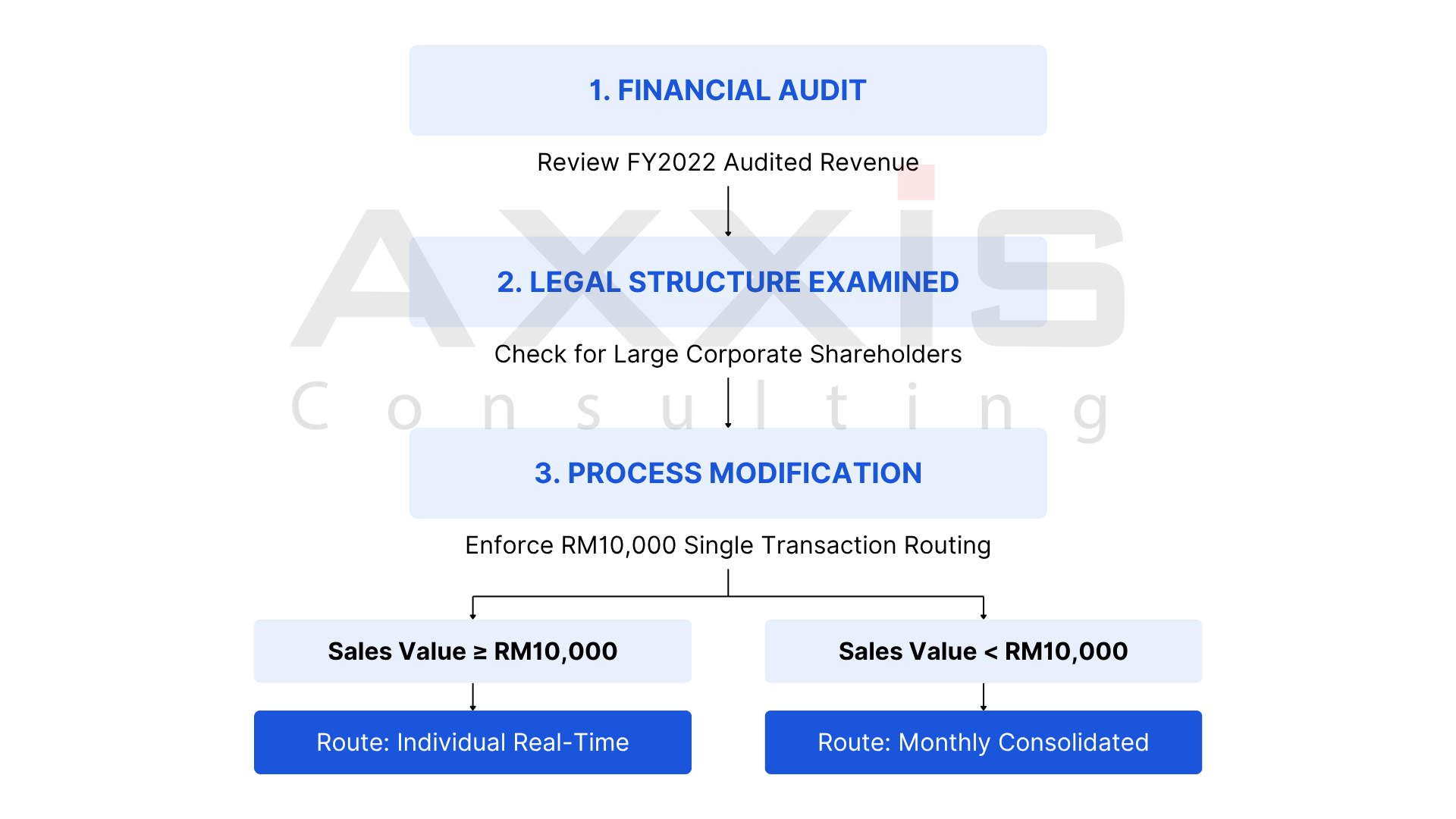
Under Section 120 of the Income Tax Act 1967, failure to issue an e-invoice, issuing incorrect digital formats, or failing to comply with validation standards constitutes a criminal offense. Convictions carry fines ranging from RM200 to RM20,000, imprisonment for up to six months, or both per individual non-compliant transaction.
Yes, but under very strict limitations. The current Phase 4 relaxation guidelines permit SMEs to group low-value B2C transactions or minor retail receipts into a single monthly consolidated e-invoice, which you must submit within seven days of the following month-end. However, this relaxation strictly excludes any B2B transaction over RM10,000, which requires instant, individual validation.
While a local accounting tool handles basic bookkeeping patches, it operates in a silo. As your business grows, your procurement, sales, and inventory teams will continue to clash due to disconnected data. A global ERP like SAP Business One unifies your entire company, provides deep multi-warehouse controls, scales with international currencies, and automates tax compliance natively without relying on unstable third-party software plug-ins.
Secure Your Growth with a Trusted SAP Platinum Partner
Implementing a new ERP is a major strategic step for any business. Therefore, you need an implementation team that understands both the technical nuances of the software and the local regulatory pressures of the Malaysian market.
At Axxis Consulting, we pride ourselves on being a premier, certified SAP Platinum Partner. For years, our localized implementation methodology has helped hundreds of mid-market enterprises across Southeast Asia transform their business operations. We design tailored deployment plans that integrate your sales pipelines, maximize your warehouse output, and ensure absolute compliance with LHDN guidelines from day one.
Do not let manual data entry and tax compliance hurdles slow down your business growth this year. Take full control of your enterprise data, protect your margins, and empower your teams with an enterprise platform built for the future.