





Enterprise software stands on the edge of its most significant evolution in decades. For years, businesses utilized ERP systems primarily as static digital filing cabinets—highly reliable systems of record that stored financial, supply chain, and customer data. Today, that paradigm has completely shattered.
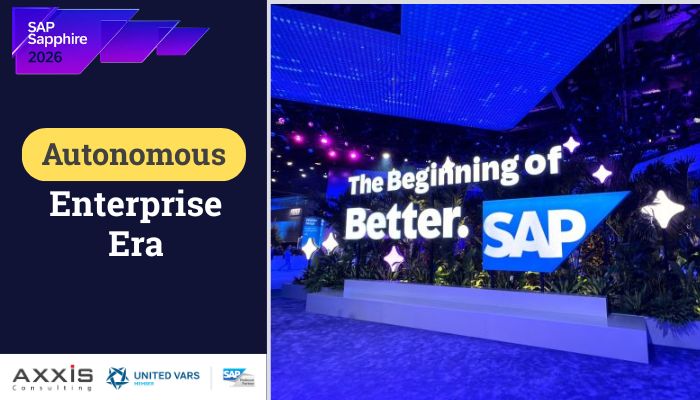
At the flagship SAP Sapphire 2026 conference, SAP explicitly moved past simple conversational chatbots and basic co-pilots. Instead, the tech giant officially introduced the era of the “Autonomous Enterprise.” By weaving multi-agent artificial intelligence directly into the core fabric of business applications, SAP aims to transform enterprise software into an active, self-optimizing system of intelligence.
If you manage a modern corporation, you no longer need to wonder how artificial intelligence will impact your daily work. The updates from SAP Sapphire 2026 prove that agentic AI will soon run, optimize, and scale your core business processes autonomously. Let us dive deep into the major AI developments from this year’s event and explore how these innovations will reshape the competitive landscape.
Unveiling the Autonomous Enterprise: Beyond Simple Automation
Over the last two years, generative AI in business focused heavily on productivity prompts, such as summarizing long text documents, drafting automated emails, or answering basic user questions.
However, SAP Sapphire 2026 marked a profound conceptual pivot toward agentic AI systems that can execute complex corporate tasks from start to finish without constant human intervention.
SAP defines the “Autonomous Enterprise” as an organization where specialized digital AI agents continuously collaborate to solve operational challenges. Instead of waiting for a human worker to pull a report, analyze a variance, and manually trigger a correction, these intelligent agents operate in the background. They monitor live workflows, detect anomalies, predict supply or demand disruptions, and execute real-time remedies across different departments.
This architectural shift fundamentally redefines human-computer interaction within an ERP system. Consequently, professionals will shift their focus from performing routine transaction entries to managing exception workflows and directing high-level strategic outcomes.
The Dremio Acquisition: Unifying Data to Fuel Agentic AI
An artificial intelligence model is only as effective as the data that feeds it. Because enterprise data traditionally remains locked away in siloed databases, legacy architectures frequently cripple advanced AI initiatives. SAP addressed this critical bottleneck head-on at Sapphire 2026 by announcing its definitive agreement to acquire Dremio.
This strategic acquisition represents a massive win for organizations struggling to bridge the gap between their SAP environments and external data platforms. Dremio specializes in data lakehouse technology and analytical query acceleration. By integrating Dremio into the SAP ecosystem, the company allows businesses to seamlessly unify SAP data with non-SAP data without moving or copying massive datasets.
Why does this matter so deeply for your AI strategy? Agentic AI systems require absolute contextual awareness to make reliable operational decisions. If an AI agent attempts to optimize your inventory levels but cannot view the real-time shipping telematics stored in an external third-party logistics database, its decisions remain flawed.
The unification of data through Dremio directly powers the next generation of SAP’s advanced AI agents. It provides them with a single, comprehensive view of truth across the entire corporate ecosystem.
Deepening Alliances: The Multi-Agent AI Push with Google Cloud
SAP understands that no single technology vendor can solve the enterprise AI puzzle alone. Therefore, the company announced a massive expansion of its strategic partnership with Google Cloud to deploy multi-agent AI architectures across shared customers.
This collaboration blends SAP’s deep corporate process expertise with Google Cloud’s advanced Gemini models and powerful infrastructure. Through this expanded integration, SAP’s digital assistant, Joule, can seamlessly converse and collaborate with specialized Google Cloud AI agents.
Consider a practical example in global corporate procurement. When a sudden geopolitical event delays a critical components shipment, the SAP procurement agent instantly flags the delivery disruption. Simultaneously, it connects with a Google Cloud agent to scan public news feeds, assess regional weather patterns, and identify alternative supplier locations.
Together, these cross-platform agents calculate the financial impact, verify vendor compliance, and draft an optimized alternative purchase order for the procurement manager’s final approval. This multi-agent ecosystem transforms complex problem-solving from days of manual research into seconds of automated collaboration.
Injecting AI into Core Business Workflows
The true value of SAP’s AI updates lies in how deeply developers embedded these features into everyday business processes. Rather than treating AI as an optional plugin or an isolated data science project, SAP injected intelligence directly into its core modules.
-
Supply Chain and Global Logistics: This year, SAP secured its position as a Leader in global logistics management for the 12th consecutive time. The latest updates supercharge supply chain visibility by using predictive AI to anticipate warehouse bottlenecks, automate freight matching, and dynamically reroute shipments based on real-time transit telemetry.
-
The Sustainability Carbon Ledger: Modern corporate governance demands granular, verifiable data regarding environmental impact. To meet this need, SAP remains fully committed to delivering an ERP-integrated carbon ledger. This framework applies AI to automate carbon accounting across complex supply chains, which empowers executive teams to make sustainable procurement choices that drive long-term corporate growth.
-
Finance and Talent Management: Across finance modules, automated agents accelerate the financial close process by automatically reconciling ledger variances. Meanwhile, in Human Capital Management, intelligent systems assist HR managers by generating precise job descriptions, analyzing skill gaps, and mapping out personalized internal career paths for top talent.
Essential Takeaways for Business Leaders and Partners
The announcements from SAP Sapphire 2026 send a clear message to the global business community: AI adoption has moved past the experimental proof-of-concept phase. To maintain a strong competitive advantage, corporate leadership must reshape their operational strategies around three main pillars:
- Prioritize Clean Data Architecture: Because SAP is optimizing its environment to ingest unified data via Dremio, your leadership team must focus heavily on data hygiene – Clean up your legacy databases now to ensure your future AI agents make optimal operational decisions.
- Prepare Your Workforce for the Autonomous Shift: Your team members must transition from being manual operators to high-level process supervisors. Invest early in training programs that teach employees how to manage, audit, and evaluate agentic workflows.
- Leverage Ecosystem Expertise: Building an autonomous enterprise requires a deep understanding of both legacy business processes and modern cloud integrations. Partnering with certified consultants helps your business align its long-term goals with SAP’s rapidly expanding cloud blueprint.
Also Read: SAP Clean Core Strategy 2026
Embracing the Future Today
SAP Sapphire 2026 proved that the autonomous enterprise is no longer a distant sci-fi vision. It is a concrete corporate reality arriving rapidly in production environments. By unifying non-SAP data lakehouses through Dremio, deploying multi-agent ecosystems alongside Google Cloud, and embedding predictive AI straight into core modules, SAP provides businesses with the definitive tools to run autonomously.
As an SAP Platinum Partner, Axxis Consulting stands ready to help you navigate this thrilling technological landscape. We assist companies in modernizing their digital core, integrating advanced tracking, and activating the power of agentic AI.


